
350-501 · Question #452
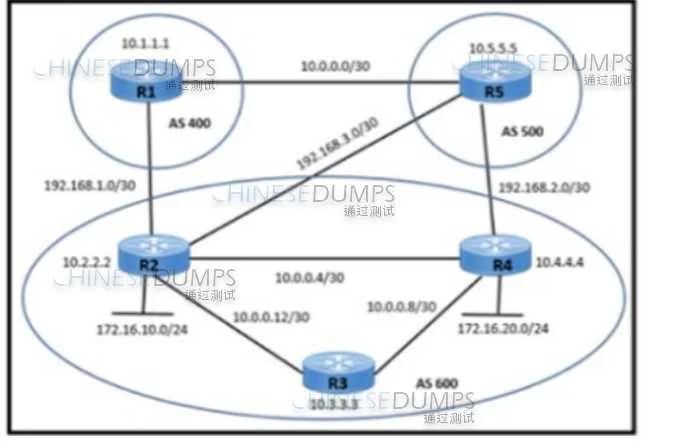
Refer to the exhibit. A network engineer is implementing iBGP and eBGP between AS 600 and AS 500 with these requirements: - R2 must establish eBGP peering on 192.168.3.0/30 with R5 for sending…
The correct answer is B. Configure advertisement-Interval 30 in address-family Ipv4 multicast. To meet the requirement of delaying BGP updates for multicast traffic by 30 seconds, the advertisement-interval command must be configured within the IPv4 multicast address family on R2, which controls the minimum time between sending BGP routing updates to a neighbor.
Question
Refer to the exhibit. A network engineer is implementing iBGP and eBGP between AS 600 and AS 500 with these requirements:
- R2 must establish eBGP peering on 192.168.3.0/30 with R5 for sending
unicast and multicast traffic
- R2 must wait for 30 seconds before sending BGP updates to R5 for
multicast traffic. Which action must be taken on R2 to meet the requirements?
Exhibit
Options
- AConfigure advertisement-interval 30 In address-family ipv4 unicast
- BConfigure advertisement-Interval 30 in address-family Ipv4 multicast
- CApply timers bgp 30 in address-family ipv4 unicast
- DApply timers bgp 30 in address-family ipv4 multicast.
How the community answered
(31 responses)- A10% (3)
- B81% (25)
- C3% (1)
- D6% (2)
Why each option
To meet the requirement of delaying BGP updates for multicast traffic by 30 seconds, the `advertisement-interval` command must be configured within the IPv4 multicast address family on R2, which controls the minimum time between sending BGP routing updates to a neighbor.
Configuring `advertisement-interval 30` in the `ipv4 unicast` address family would apply the delay to unicast updates, not multicast, which is not what the requirement specifies.
The `advertisement-interval` command, when configured within a specific address-family (like `ipv4 multicast`), directly controls the minimum interval that must pass before BGP sends routing updates for routes within that family to a neighbor. Setting this to 30 seconds for IPv4 multicast on R2 will ensure that BGP waits at least 30 seconds before propagating multicast routing updates to R5, fulfilling the requirement.
The `timers bgp` command sets the BGP keepalive and hold timers for session maintenance, not the interval between sending routing updates for a specific address family. Applying it to `ipv4 unicast` would further miss the target traffic type.
Similar to option C, `timers bgp` affects session keepalives and holds, not update intervals, and applying it to `ipv4 multicast` would not achieve the desired delay in sending updates.
Concept tested: BGP advertisement-interval for specific address families
Source: https://www.cisco.com/c/en/us/td/docs/ios-xml/ios/iproute_bgp/command/bgp-cr-a1.html#wp2211475752
Topics
Community Discussion
No community discussion yet for this question.