
350-501 · Question #351
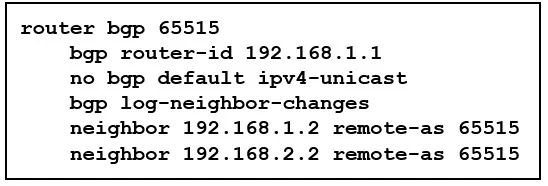
Refer to the exhibit. A network engineer is configuring a new router for iBGP to improve the capacity of a growing network. The router must establish an iBGP peer relationship with its neighbor. The…
The correct answer is D. Activate the BGP peers under the correct address family on the router. Activating BGP peers under the correct address family (option D) is the missing step because, in modern BGP configurations, simply defining a neighbor with neighbor x.x.x.x remote-as is not enough - you must explicitly activate that neighbor under the appropriate address family…
Question
Refer to the exhibit. A network engineer is configuring a new router for iBGP to improve the capacity of a growing network. The router must establish an iBGP peer relationship with its neighbor. The underlay network is already configured with the correct IP addresses. Which step should the engineer apply to complete this task?
Exhibit
Options
- AImplement multicast routing on the router to support BGP hellos.
- BConfigure the AS number for the router to share with its iBGP peers.
- CConfigure the new router as an iBGP route reflector to support multiple iBGP peers.
- DActivate the BGP peers under the correct address family on the router.
How the community answered
(34 responses)- A3% (1)
- B15% (5)
- C6% (2)
- D76% (26)
Explanation
Activating BGP peers under the correct address family (option D) is the missing step because, in modern BGP configurations, simply defining a neighbor with neighbor x.x.x.x remote-as is not enough - you must explicitly activate that neighbor under the appropriate address family (e.g., address-family ipv4 unicast) before the peer session can exchange prefixes. Option A is wrong because BGP uses TCP (port 179), not multicast - no multicast routing is needed for BGP hellos. Option B is wrong because in iBGP, all peers already share the same AS number by definition, so there is nothing new to configure there. Option C is wrong because a route reflector is only needed when you have many iBGP peers and want to avoid a full mesh - a single new peer relationship doesn't require it.
Memory tip: Think of address-family activation as "flipping the switch" - you can wire up a neighbor all day, but the BGP session won't pass traffic for a given protocol until you activate it inside the right address family. If a peer is defined but not exchanging routes, activation is almost always the culprit.
Topics
Community Discussion
No community discussion yet for this question.