
350-501 · Question #352
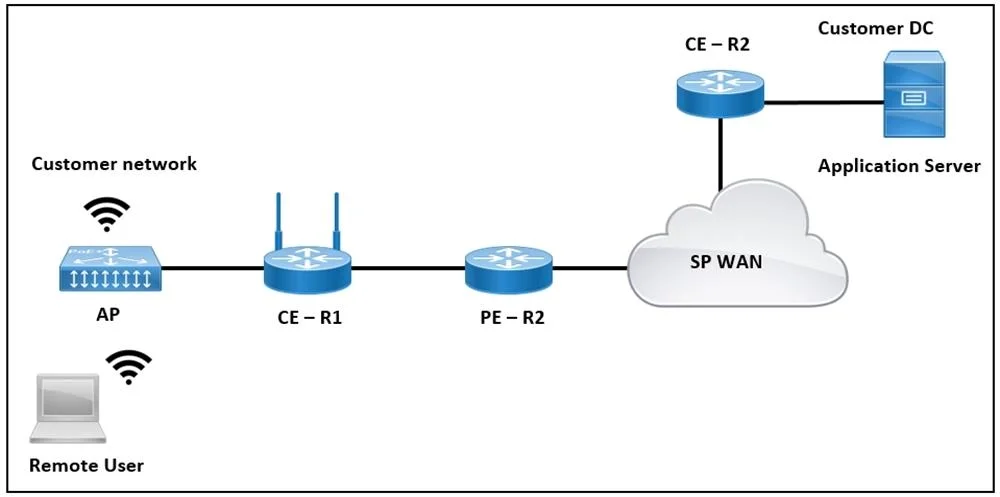
Refer to the exhibit. The application server in the data center hosts voice, video, and data applications over the internet. The data applications run more slowly than the voice and video…
The correct answer is A. Configure the scheduling function to handle delayed packets. C. Configure a queue to buffer excess traffic. Traffic shaping works by buffering excess packets (not dropping them) and then scheduling their delayed transmission - so both a queue (C) and a scheduling function (A) are required components of any shaping implementation. Without a queue to hold excess traffic, there's…
Question
Refer to the exhibit. The application server in the data center hosts voice, video, and data applications over the internet. The data applications run more slowly than the voice and video applications. To ensure that all applications run smoothly, the service provider decided to implement a QoS policy on router PER 2 to apply traffic shaping. Which two actions must an engineer take to implement the task? (Choose two.)
Exhibit
Options
- AConfigure the scheduling function to handle delayed packets.
- BEnable packet remarking for priority traffic.
- CConfigure a queue to buffer excess traffic.
- DSet the token value for secondary traffic.
- ESet a threshold to discard excess traffic.
How the community answered
(24 responses)- A79% (19)
- B4% (1)
- D13% (3)
- E4% (1)
Explanation
Traffic shaping works by buffering excess packets (not dropping them) and then scheduling their delayed transmission - so both a queue (C) and a scheduling function (A) are required components of any shaping implementation. Without a queue to hold excess traffic, there's nowhere to store packets that exceed the shaped rate; without a scheduler, the router has no mechanism to release those delayed packets in an orderly, rate-controlled fashion.
Why the distractors are wrong:
- B (Remarking) is a marking/classification action, not a shaping action - shaping doesn't change DSCP or CoS values.
- D (Token value for secondary traffic) misrepresents how token buckets work; token bucket parameters define the shaping rate, but "setting the token value for secondary traffic" is not a recognized shaping configuration step.
- E (Discard excess traffic) describes traffic policing, which drops non-conforming packets - the opposite of shaping, which retains them in a buffer.
Memory tip: Think of the key difference as Shape = Store & Schedule vs. Police = Punish (drop). Any shaping solution must have something to store traffic (queue = C) and something to schedule its release (scheduling function = A).
Topics
Community Discussion
No community discussion yet for this question.