
350-501 · Question #350
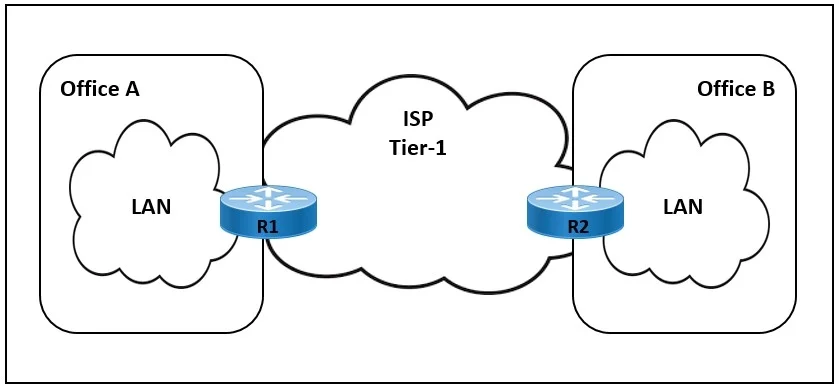
Refer to the exhibit. The link between Office A and Office B is running at 90% load, and occasionally the CPU on router R1 is overloaded. The company implemented QoS for business- critical…
The correct answer is D. Configure BFD echo mode with the command bfd interval 150 min_rx 200 multiplier 3. Option D is correct because BFD echo mode offloads hello packet processing to the forwarding plane rather than the control plane, directly reducing R1's CPU load. The detection timer math also lands exactly on the requirement: min_rx (200ms) × multiplier (3) = 600ms detection…
Question
Refer to the exhibit. The link between Office A and Office B is running at 90% load, and occasionally the CPU on router R1 is overloaded. The company implemented QoS for business- critical applications at both offices as a temporary solution. A network engineer must update the R1 configuration to 600 ms to reduce CPU load and limit downtime after connection failure to avoid data loss. Which action meets this requirement?
Exhibit
Options
- AConfigure the fast-hello feature for OSPF with the command ip ospf dead-interval minimal hello-
- BConfigure BFD demand mode with the command bfd-demand timer 150 interval 250 retransmit 5.
- CConfigure BFD non-echo mode with the command echo interval 250 minimal 300 echo-multiplier
- DConfigure BFD echo mode with the command bfd interval 150 min_rx 200 multiplier 3.
How the community answered
(17 responses)- A12% (2)
- C6% (1)
- D82% (14)
Explanation
Option D is correct because BFD echo mode offloads hello packet processing to the forwarding plane rather than the control plane, directly reducing R1's CPU load. The detection timer math also lands exactly on the requirement: min_rx (200ms) × multiplier (3) = 600ms detection time, satisfying both criteria simultaneously.
Why the distractors fail:
- Option A - OSPF fast-hello (
dead-interval minimal) achieves a minimum dead interval of 1000ms (1 second), not 600ms, and still burdens the CPU because OSPF control packets are processed at the process level. - Option B - BFD demand mode is designed for stable, known-good links and suppresses periodic hellos entirely; it's not suited for detecting failures quickly, and the command syntax (
bfd-demand timer) is non-standard IOS. - Option C - BFD non-echo mode forces both devices to process BFD control packets via the CPU, which is the opposite of what's needed to reduce CPU load; the command syntax is also invalid.
Memory tip: Think "Echo = Efficiency." In BFD echo mode, the remote router simply bounces the packets back through its forwarding ASIC - no CPU wake-up required. The formula to remember is min_rx × multiplier = detection time (200 × 3 = 600ms).
Topics
Community Discussion
No community discussion yet for this question.