
350-501 · Question #339
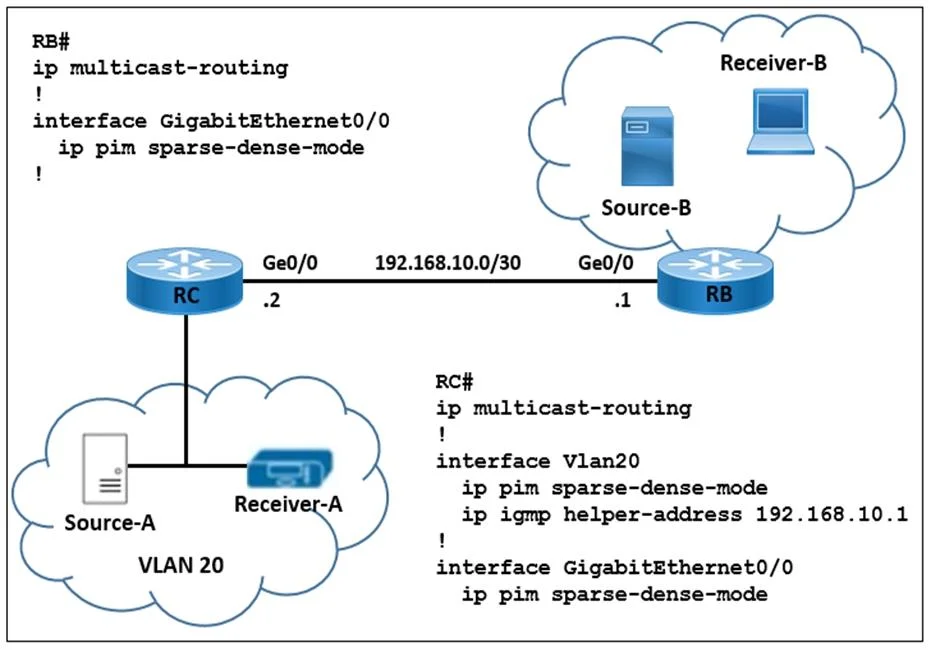
Refer to the exhibit. A network engineer is implementing multicast Source-A to send a multicast stream for Receiver-A, and multicast Source-B to send a multicast stream for Receiver-B. Router RC…
The correct answer is D. Enable ip pim passive on RB interface Ge0/0. To prevent unwanted multicast flooding from Source-A to Router RB, configure ip pim passive on RB's interface Ge0/0, which disables PIM adjacency formation and routing participation on that interface.
Question
Refer to the exhibit. A network engineer is implementing multicast Source-A to send a multicast stream for Receiver-A, and multicast Source-B to send a multicast stream for Receiver-B. Router RC forwards the IGMP host a report and leaves messages to IP address 192.168.10.1. How must the multicast features be implemented to prevent RB from receiving multicast flooding from Source-A?
Exhibit
Options
- AChange the helper-address value to 192.168.10.2 on RC.
- BEnable ip pim neighbor-filter on RC interface Ge0/0.
- CConfigure PIM-SSM on RB and RC interface Ge 0/0.
- DEnable ip pim passive on RB interface Ge0/0.
How the community answered
(40 responses)- A8% (3)
- B3% (1)
- C15% (6)
- D75% (30)
Why each option
To prevent unwanted multicast flooding from Source-A to Router RB, configure `ip pim passive` on RB's interface Ge0/0, which disables PIM adjacency formation and routing participation on that interface.
`helper-address` is used for forwarding broadcast-based services like DHCP, not for controlling multicast PIM behavior or preventing multicast flooding.
`ip pim neighbor-filter` is used to control which PIM neighbors are formed, which is a security feature, but `ip pim passive` is a more direct way to prevent all PIM operations on an interface to stop unwanted flooding.
While PIM-SSM can help by requiring explicit (S,G) joins, `ip pim passive` directly addresses the 'flooding' issue by stopping PIM protocol activity on an interface that should not be routing multicast.
Enabling `ip pim passive` on an interface causes the router to stop sending and receiving PIM Hello messages on that interface, effectively disabling PIM neighbor adjacencies. This prevents the router from actively participating in PIM routing and stops it from receiving or forwarding unwanted multicast traffic on that segment, thus preventing flooding from Source-A to RB.
Concept tested: PIM passive interface configuration
Source: https://www.cisco.com/c/en/us/td/docs/ios/ipmulti/command/reference/imc_book/imc_i1.html#wp1077755
Topics
Community Discussion
No community discussion yet for this question.