
350-501 · Question #336
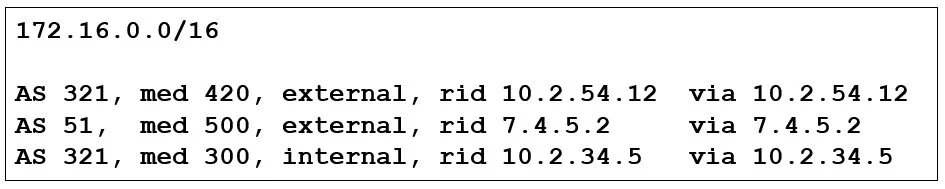
Refer to the exhibit. Tier 2 ISP A on AS 653 is connected to two Tier 1 ISPs on AS 321 and AS 51 respectively. The network architect at ISP A is planning traffic flow inside the network to provide…
The correct answer is A. Implement the BGP routing protocol and run the bgp deterministic-med command. To consistently direct all BGP traffic through a specific Tier 1 ISP when Cisco Express Forwarding is disabled, the architect should use bgp deterministic-med to ensure predictable MED comparison during path selection.
Question
Refer to the exhibit. Tier 2 ISP A on AS 653 is connected to two Tier 1 ISPs on AS 321 and AS 51 respectively. The network architect at ISP A is planning traffic flow inside the network to provide predictable network services. Cisco Express Forwarding is disabled on the edge router. How should the architect implement BGP to direct all traffic via the Tier 1 ISP with next-hop 7.4.5.2?
Exhibit
Options
- AImplement the BGP routing protocol and run the bgp deterministic-med command.
- BImplement MP-BGP with a 4-byte AS number with the bgp best path compare-routerid command.
- CImplement the BGP routing protocol and the maximum-paths 2 configuration.
- DImplement BGP route-reflector functionality with the bgp always-compare-med configuration.
How the community answered
(51 responses)- A71% (36)
- B4% (2)
- C10% (5)
- D16% (8)
Why each option
To consistently direct all BGP traffic through a specific Tier 1 ISP when Cisco Express Forwarding is disabled, the architect should use `bgp deterministic-med` to ensure predictable MED comparison during path selection.
The `bgp deterministic-med` command ensures that BGP deterministically compares the MED attribute among paths received from external BGP (eBGP) peers in the same autonomous system, even if they are not from the same neighbor or neighbor AS. This allows the network architect to use MED values to consistently influence inbound traffic steering and ensure all traffic exits through the desired Tier 1 ISP when CEF is disabled.
MP-BGP with 4-byte AS numbers and `bgp best path compare-routerid` are for specific advanced BGP scenarios and tie-breaking, not the primary mechanism to direct all traffic via a specific next-hop by influencing MED consistently when CEF is disabled.
`maximum-paths 2` enables Equal-Cost Multi-Path (ECMP) routing, which would split traffic across both Tier 1 ISPs, contrary to the goal of directing all traffic via one specific ISP, and it is less relevant when CEF is disabled for consistent path selection.
BGP route-reflector functionality is used to scale iBGP within an AS and `bgp always-compare-med` compares MEDs regardless of AS, but `bgp deterministic-med` is specifically for consistent MED comparison across different eBGP peers from the same AS, which is relevant here.
Concept tested: BGP path selection - deterministic MED
Source: https://www.cisco.com/c/en/us/td/docs/ios-xml/ios/iproute_bgp/command/bgp-cr-h1/bgp-cr-b1.html#wp1074092671
Topics
Community Discussion
No community discussion yet for this question.