
350-501 · Question #335
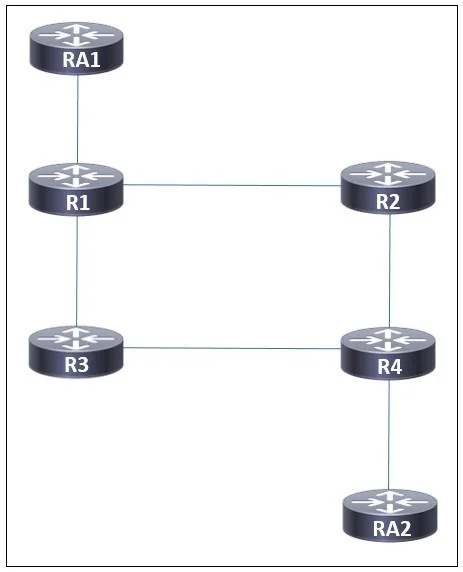
Refer to the exhibit. A network administrator implemented MPLS routing between routers R1, R2, R3, and R4. AToM is configured between R1 and R4 to allow Layer 2 traffic from hosts on RA1 and RA2. A…
The correct answer is A. Disable the MPLS LDP IGP sync holddown. To ensure that LDP synchronization properly occurs, meaning the IGP consistently waits for LDP session establishment before advertising an interface, any configured LDP IGP sync holddown timer should be disabled. This prevents the IGP from prematurely advertising the interface…
Question
Refer to the exhibit. A network administrator implemented MPLS routing between routers R1, R2, R3, and R4. AToM is configured between R1 and R4 to allow Layer 2 traffic from hosts on RA1 and RA2. A targeted MPLS session is established between R1 and R4. Which additional action must the administrator take on all routers so that LDP synchronization occurs between connected LDP sessions?
Exhibit
Options
- ADisable the MPLS LDP IGP sync holddown.
- BConfigure OSPF or IS-IS as the routing protocol.
- CConfigure EIGRP as the routing protocol using stub areas only.
- DEnable MPLS LDP sync delay timers.
How the community answered
(44 responses)- A82% (36)
- B2% (1)
- C9% (4)
- D7% (3)
Why each option
To ensure that LDP synchronization properly occurs, meaning the IGP consistently waits for LDP session establishment before advertising an interface, any configured LDP IGP sync holddown timer should be disabled. This prevents the IGP from prematurely advertising the interface if LDP convergence exceeds the holddown period.
The `mpls ldp igp sync holddown` command specifies a maximum time for the IGP to wait for LDP to establish a session. If LDP takes longer than this holddown period, the IGP will advertise the interface regardless, effectively breaking the synchronization. Disabling the holddown (using `no mpls ldp igp sync holddown`) ensures that the IGP will continue to wait for LDP convergence, thereby allowing LDP synchronization to fully occur and preventing premature traffic forwarding.
While OSPF or IS-IS are the preferred IGPs for MPLS LDP synchronization, the question implies MPLS routing is already "implemented," which often suggests a suitable IGP is already running. Configuring a new IGP would be a major change rather than an "additional action" to make synchronization occur, unless the existing IGP is incompatible.
EIGRP can work with LDP, but "stub areas only" is an EIGRP feature irrelevant to LDP synchronization. Moreover, EIGRP is generally less integrated with LDP synchronization mechanisms than OSPF or IS-IS.
Enabling MPLS LDP sync delay timers would prolong the wait time for synchronization, which could exacerbate issues if synchronization is already failing or taking too long, rather than ensuring it "occurs."
Concept tested: MPLS LDP IGP Synchronization holddown
Source: https://www.cisco.com/c/en/us/td/docs/ios-xml/ios/mp_ldp/configuration/xe-3s/mp-ldp-xe-3s-book/mp-ldp-igp-sync.html
Topics
Community Discussion
No community discussion yet for this question.