
350-501 · Question #334
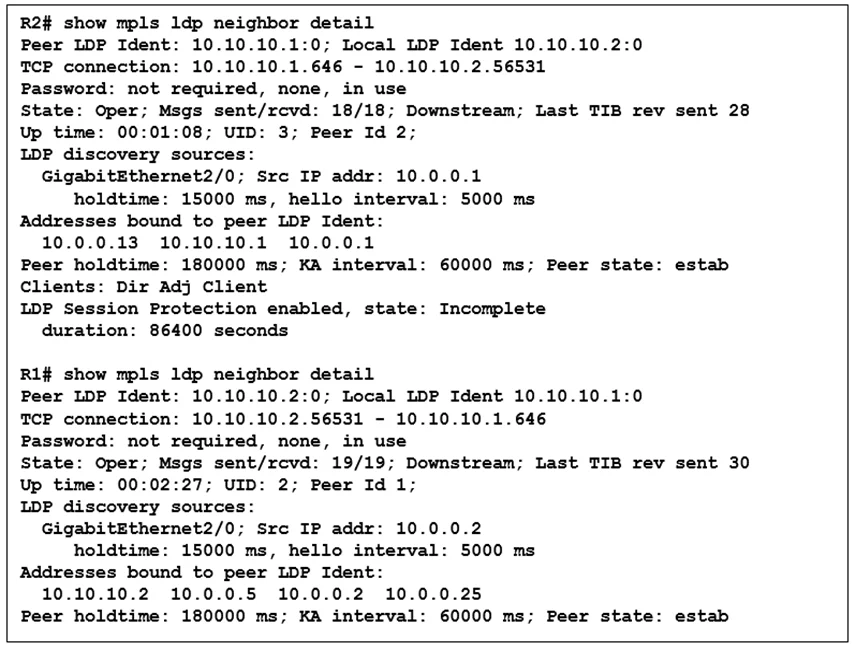
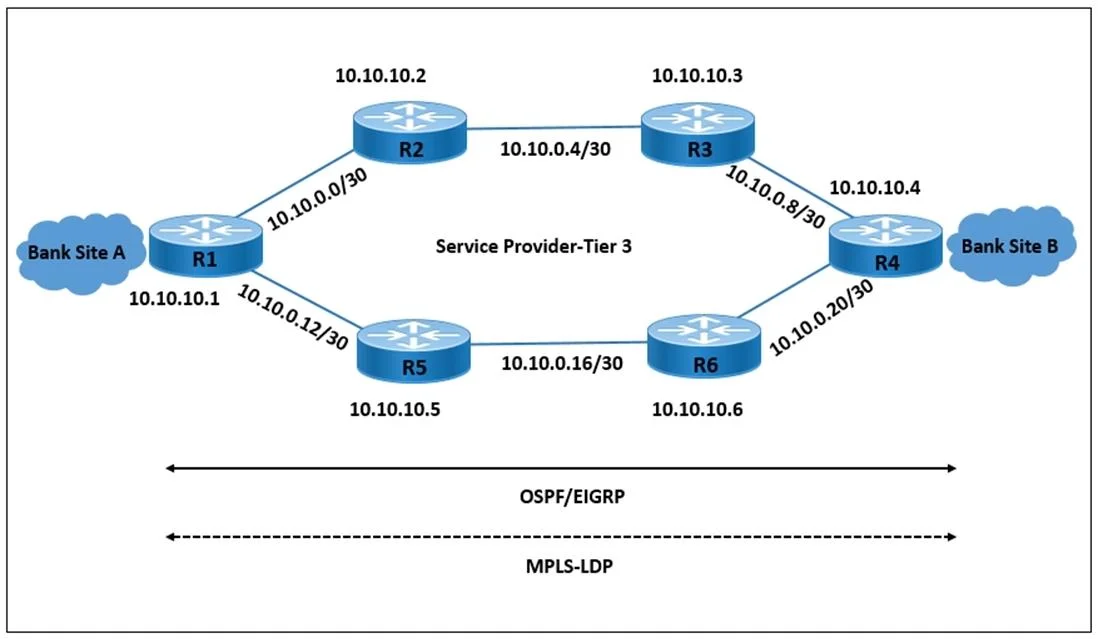
Refer to the exhibit. LDP peering between routers R1 and R2 is dropped when the link between R1 and R2 is taken offline. However, LDP peering between R2 and R3 stays up when the link between R2 and…
The correct answer is B. Implement LDP Session Protection on R1. To ensure MPLS traffic forwarding continues when a direct link fails, LDP session protection must be implemented. This feature allows an LDP session to remain active over an alternate IGP path, preventing the session from dropping even if the direct interface goes down.
Question
Refer to the exhibit. LDP peering between routers R1 and R2 is dropped when the link between R1 and R2 is taken offline. However, LDP peering between R2 and R3 stays up when the link between R2 and R3 is taken offline. Which action allows MPLS traffic forwarding to continue normally if the link between R1 and R2 goes down?
Exhibits
Options
- AEnable IGP and LDP Synchronization on R1.
- BImplement LDP Session Protection on R1.
- CEnable IGP and LDP Synchronization on R2.
- DImplement LDP Session Protection on R2.
How the community answered
(69 responses)- A12% (8)
- B81% (56)
- C6% (4)
- D1% (1)
Why each option
To ensure MPLS traffic forwarding continues when a direct link fails, LDP session protection must be implemented. This feature allows an LDP session to remain active over an alternate IGP path, preventing the session from dropping even if the direct interface goes down.
IGP and LDP Synchronization is a feature that prevents MPLS traffic blackholing by delaying IGP advertisement until LDP is fully converged. It does not maintain LDP sessions across physical link failures.
LDP Session Protection allows the LDP session between R1 and R2 to remain active even if the direct link fails, provided there is an alternate IP path (through the IGP) to reach the LDP peer's loopback address. This ensures that MPLS traffic forwarding can continue normally over the redundant path without label disruption.
Similar to option A, IGP and LDP Synchronization on R2 would not address the issue of the LDP session dropping between R1 and R2 when the direct link fails.
The problem states that LDP peering between R2 and R3 already stays up, suggesting LDP Session Protection is already at play on R2 for R3. The issue is with R1-R2, and R1 needs to be configured to protect its session to R2.
Concept tested: MPLS LDP Session Protection
Source: https://www.cisco.com/c/en/us/td/docs/ios-xml/ios/mp_ldp/configuration/xe-3s/mp-ldp-xe-3s-book/mp-ldp-sess-prot.html
Topics
Community Discussion
No community discussion yet for this question.