
350-501 · Question #209
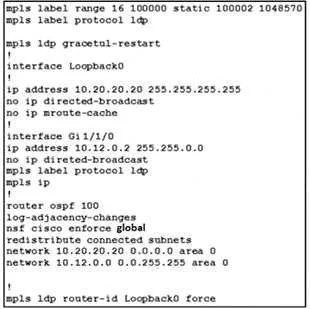
Refer to the exhibit. A network administrator implemented MPLS LDP changes on PE-A LSR device. The engineer must ensure there are no LDP peer are fully operational. Which LDP feature must the…
The correct answer is B. Configure MPLS LDP NSR for all LDP sessions. MPLS LDP Non-Stop Routing (NSR) allows an LDP router to maintain its LDP session state and forwarding table across a control-plane event (such as a route processor switchover or configuration change) without the LDP peer detecting any session disruption. By configuring NSR for…
Question
Refer to the exhibit. A network administrator implemented MPLS LDP changes on PE-A LSR device. The engineer must ensure there are no LDP peer are fully operational. Which LDP feature must the engineer apply to the existing configuration to eliminate the problem?
Exhibit
Options
- AConfigure MPLS LDP IGP synchronization on the network.
- BConfigure MPLS LDP NSR for all LDP sessions.
- CEnable LDP session protection under the routing protocol.
- DDisable IP CEF on routers LDP and enable
How the community answered
(29 responses)- A3% (1)
- B79% (23)
- C10% (3)
- D7% (2)
Explanation
MPLS LDP Non-Stop Routing (NSR) allows an LDP router to maintain its LDP session state and forwarding table across a control-plane event (such as a route processor switchover or configuration change) without the LDP peer detecting any session disruption. By configuring NSR for all LDP sessions, the PE-A router ensures that LDP adjacencies remain fully operational even during maintenance changes. Option A (LDP IGP Synchronization) prevents traffic blackholing during IGP/LDP convergence mismatches but does not protect sessions during direct LDP changes. Option C (LDP session protection) preserves LDP sessions during link failures using targeted LDP, which is a different use case. Option D is incorrect and counterproductive - disabling CEF would break MPLS forwarding entirely.
Topics
Community Discussion
No community discussion yet for this question.