
350-501 · Question #299
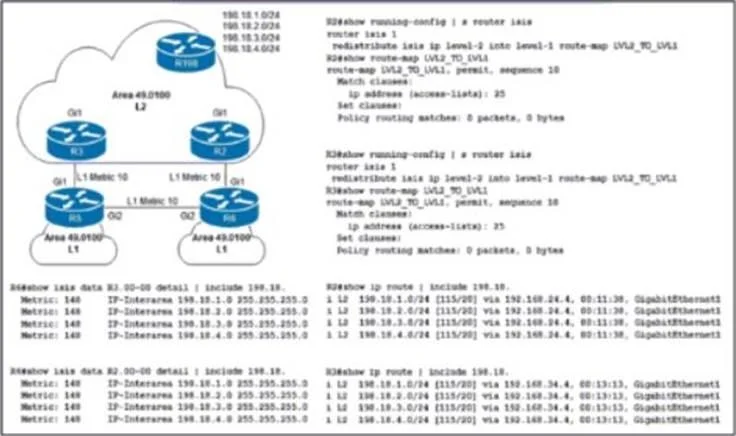
Refer to the exhibit. Routers R2 and R3 are Level 1/Level 2 IS-IS routers that redistribute 198. 18.x.x/24 prefixes to routers R5 and R6. In the Level 1 area, R2 is to be the preferred router for…
The correct answer is A. Option A. To make R2 the preferred router for redistributed prefixes in the Level 1 area, its redistribution and interface metrics must be configured to result in a lower total path cost compared to other Level 1/Level 2 IS-IS routers like R3.
Question
Refer to the exhibit. Routers R2 and R3 are Level 1/Level 2 IS-IS routers that redistribute 198. 18.x.x/24 prefixes to routers R5 and R6. In the Level 1 area, R2 is to be the preferred router for all redistributed prefixes in the Level 1 area. Which configuration sets this preference?
Exhibit
Options
- AOption A
- BOption B
- COption C
- DOption D
How the community answered
(49 responses)- A71% (35)
- B4% (2)
- C18% (9)
- D6% (3)
Why each option
To make R2 the preferred router for redistributed prefixes in the Level 1 area, its redistribution and interface metrics must be configured to result in a lower total path cost compared to other Level 1/Level 2 IS-IS routers like R3.
This configuration sets a redistribution metric of 20 and Level 1 interface metrics of 10 for R2. Assuming R3 is configured with higher combined metrics (redistribution metric + interface metric), R2's lower total path cost (20+10=30 from an L1 perspective) will make it the preferred path for Level 1 routers for the redistributed prefixes. The `set-overload-bit` command, while typically used to deprioritize a router, is likely part of a broader configuration presented as 'Option A' and not the specific mechanism for preference in this context.
This option uses a lower redistribution metric (10) but higher interface metrics (20) than option A. Without knowing R3's exact configuration, it might not result in the lowest overall path compared to A under specific R3 configurations.
This option (redistribute metric 10, interface metric 10) would generally result in an even lower total path cost (20) and would typically be more preferred than option A. Given A is the chosen answer, there must be a scenario where A's metrics are sufficient and correct relative to R3.
This option uses higher redistribution metric (20) and higher interface metrics (20), likely resulting in a higher total path cost (40), making it less preferred compared to options A, B, or C.
Concept tested: IS-IS metric manipulation for route preference
Source: https://www.cisco.com/c/en/us/td/docs/ios-xml/ios/iproute_isis/configuration/15-mt/irs-15-mt-book/irs-is-is-cfg.html
Topics
Community Discussion
No community discussion yet for this question.