
350-501 · Question #298
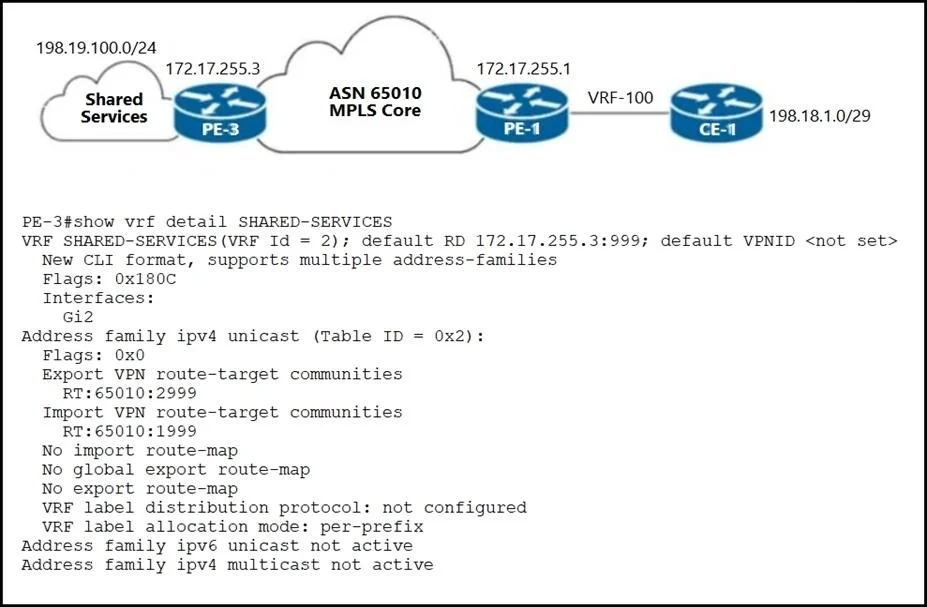
Refer to the exhibit. An ISP provides shared VoIP Extranet services to a customer in VRF-100 with these settings: - The VoIP services are hosted in the 198.19.100.0/24 space. - The customer has been…
The correct answer is D. vrf definition VRF-100. To provision VRF-100 and provide access to shared VoIP extranet services, PE-1 must be configured with its own route distinguisher and route targets, along with an additional import route target and a route-map to selectively import the shared VoIP prefixes from the extranet VRF.
Question
Refer to the exhibit. An ISP provides shared VoIP Extranet services to a customer in VRF-100 with these settings:
- The VoIP services are hosted in the 198.19.100.0/24 space.
- The customer has been assigned the 198.18.1.0/29 IP address block.
- VRF-100 is assigned import and export route target 65010:100.
Which configuration must the engineer apply to PE-1 to provision VRF-100 and provide access to the shared services?
Exhibit
Options
- Avrf definition VRF-100
- Bvrf definition VRF-100
- Cvrf definition VRF-100
- Dvrf definition VRF-100
How the community answered
(36 responses)- A11% (4)
- B6% (2)
- C3% (1)
- D81% (29)
Why each option
To provision VRF-100 and provide access to shared VoIP extranet services, PE-1 must be configured with its own route distinguisher and route targets, along with an additional import route target and a route-map to selectively import the shared VoIP prefixes from the extranet VRF.
This option only includes the customer VRF's own import/export RT (65010:100) and attempts to use an `import map` without an additional `route-target import` for the shared services, which would prevent the extranet routes from being received.
This option includes `route-target import 65010:200` but places `import map VoIP-Extranet-Import-Map` with incorrect syntax under `address-family ipv4 unicast`, which is not the correct way to apply a route-map for import filtering in the context of route targets.
This option correctly specifies the additional `route-target import 65010:200` but lacks any mechanism, such as a route-map, to filter and selectively import only the VoIP service prefixes, which is essential for extranet design.
This configuration correctly sets up VRF-100 with its primary route distinguisher and export/import route targets (65010:100). Crucially, it includes an additional `route-target import 65010:200` to receive routes from the shared VoIP extranet VRF, and uses a `route-map VoIP-Extranet-Import-Map import` to filter and import only the relevant shared VoIP service prefixes (198.19.100.0/24) into VRF-100.
Concept tested: MPLS L3VPN extranet services configuration
Source: https://www.cisco.com/c/en/us/td/docs/ios-xml/ios/iproute_bgp/configuration/xe-3s/asr1000/b_bgp_xe_3s_asr1000_chapter_0100.html
Topics
Community Discussion
No community discussion yet for this question.