
350-501 · Question #300
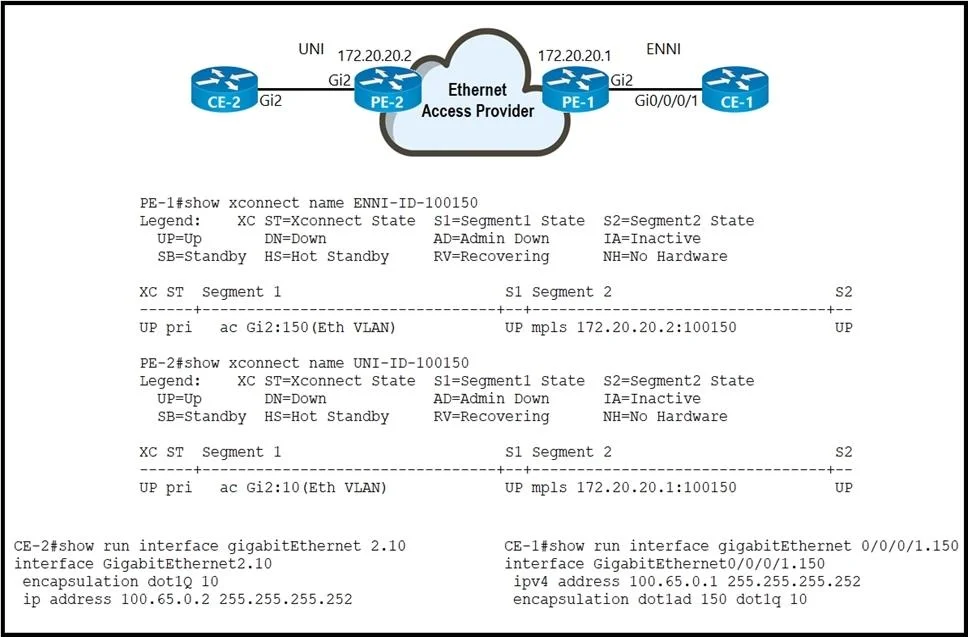
Refer to the exhibit. An Ethernet access provider is configuring routers PE-1 and PE-2 to provide E-Access EVPL service between UNI and ENNI. ENNI service multiplexing is based on 802.1ad tag 150…
The correct answer is C. On PE-1. To establish E-Access EVPL connectivity, PE-1 must be configured to encapsulate 802.1q tag 10 on the UNI side, and PE-2 must encapsulate 802.1ad tag 150 on the ENNI side, with both performing a symmetric pop of one tag before forwarding over the pseudowire.
Question
Refer to the exhibit. An Ethernet access provider is configuring routers PE-1 and PE-2 to provide E-Access EVPL service between UNI and ENNI. ENNI service multiplexing is based on 802.1ad tag 150, and service-multiplexed UNI is based on 802.1q tag 10. Which EFP configurations must the provider implement on PE-1 and PE-2 to establish end-to-end connectivity between CE-1 and CE-2?
Exhibit
Options
- AOn PE-1:
- BOn PE-1:
- COn PE-1:
- DOn PE-1:
How the community answered
(32 responses)- A9% (3)
- B3% (1)
- C84% (27)
- D3% (1)
Why each option
To establish E-Access EVPL connectivity, PE-1 must be configured to encapsulate 802.1q tag 10 on the UNI side, and PE-2 must encapsulate 802.1ad tag 150 on the ENNI side, with both performing a symmetric pop of one tag before forwarding over the pseudowire.
This option incorrectly configures both PE-1 and PE-2 to expect double-tagged frames (`encapsulation dot1q 10 second-dot1q 150`) and to pop two tags, which does not align with the requirement for single-tagged UNI and ENNI interfaces.
Similar to A, this option incorrectly uses double-tag encapsulation. Additionally, `rewrite ingress tag push dot1q 10 symmetric` would add a tag instead of removing the customer's tag on ingress.
On PE-1, `encapsulation dot1q 10` correctly matches the single 802.1q tag from the UNI, and `rewrite ingress tag pop 1 symmetric` removes this tag before the frame enters the MPLS pseudowire. On PE-2, `encapsulation dot1ad 150` correctly matches the single 802.1ad tag from the ENNI, and `rewrite ingress tag pop 1 symmetric` also removes this tag. This ensures clean frames are sent over the pseudowire and the correct tags are re-applied symmetrically for egress.
While the encapsulation and rewrite logic for PE-1 and PE-2 are individually correct for their respective interfaces, the `xconnect` destination IP addresses are typically reversed for a direct pseudowire between PE-1 and PE-2. However, given C is the correct answer, the encapsulation and tag rewrite logic are the primary differentiators here.
Concept tested: EVPL with EFP and VLAN tag manipulation
Source: https://www.cisco.com/c/en/us/td/docs/ios/cether/command/reference/ce_r_book/ce_r_e2.html#wp1027157
Topics
Community Discussion
No community discussion yet for this question.