
350-501 · Question #301
Refer to the exhibit. An administrator working for large ISP must connect its two POP sites to provide internet connectivity to its customers. Which configuration must the administrator perform to…
The correct answer is D. PE2#configure terminal. To establish an iBGP session between PEs for customer internet connectivity via MPLS L3VPN, the PE routers must be configured with an iBGP neighbor relationship using loopback interfaces, along with activating the relevant address families to exchange customer routes within…
Question
Refer to the exhibit. An administrator working for large ISP must connect its two POP sites to provide internet connectivity to its customers. Which configuration must the administrator perform to establish an iBGP session between routers PE1 on POP site 1 and PE2 on POP site 2?
Exhibit
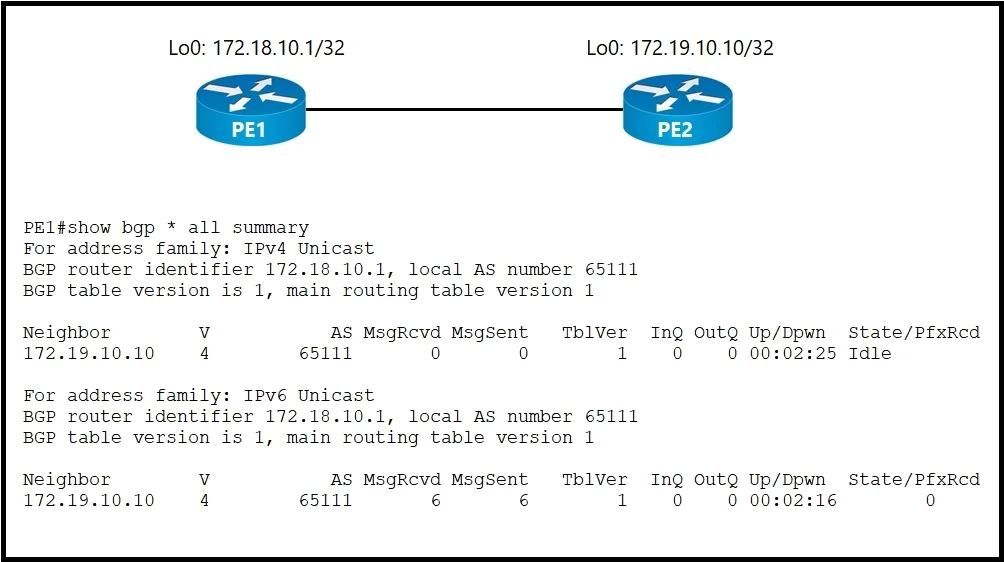
Options
- APE2#configure terminal
- BPE1#configure terminal
- CPE1#configure terminal
- DPE2#configure terminal
How the community answered
(56 responses)- A14% (8)
- B5% (3)
- C4% (2)
- D77% (43)
Why each option
To establish an iBGP session between PEs for customer internet connectivity via MPLS L3VPN, the PE routers must be configured with an iBGP neighbor relationship using loopback interfaces, along with activating the relevant address families to exchange customer routes within their respective VRFs.
This option provides a correct iBGP neighbor configuration for PE2 but lacks the configuration for the `address-family` specific to handling customer VRF routes, which is crucial for providing customer internet connectivity via L3VPN.
This option incorrectly includes the `ebgp-multihop 255` command, which is not applicable to iBGP peering and is specifically for eBGP sessions over non-directly connected interfaces.
Similar to A, this option provides a correct iBGP neighbor configuration for PE1 but does not include the necessary `address-family` configuration for exchanging customer VRF routes.
This configuration on PE2 correctly establishes an iBGP neighbor relationship with PE1 (10.0.0.1) using the local Loopback0 as the update source, which is standard for PE-PE iBGP peering. Furthermore, it activates BGP for `address-family ipv4 vrf VPN1`, which is necessary for exchanging IPv4 customer routes within the context of VRF VPN1, thus contributing to providing internet connectivity for customers.
Concept tested: iBGP PE-PE peering for L3VPN with VRF
Source: https://www.cisco.com/c/en/us/td/docs/ios/iproute_bgp/configuration/15-mt/irg-15-mt-book/irg-mp-bgp.html
Topics
Community Discussion
No community discussion yet for this question.