
350-401 · Question #985
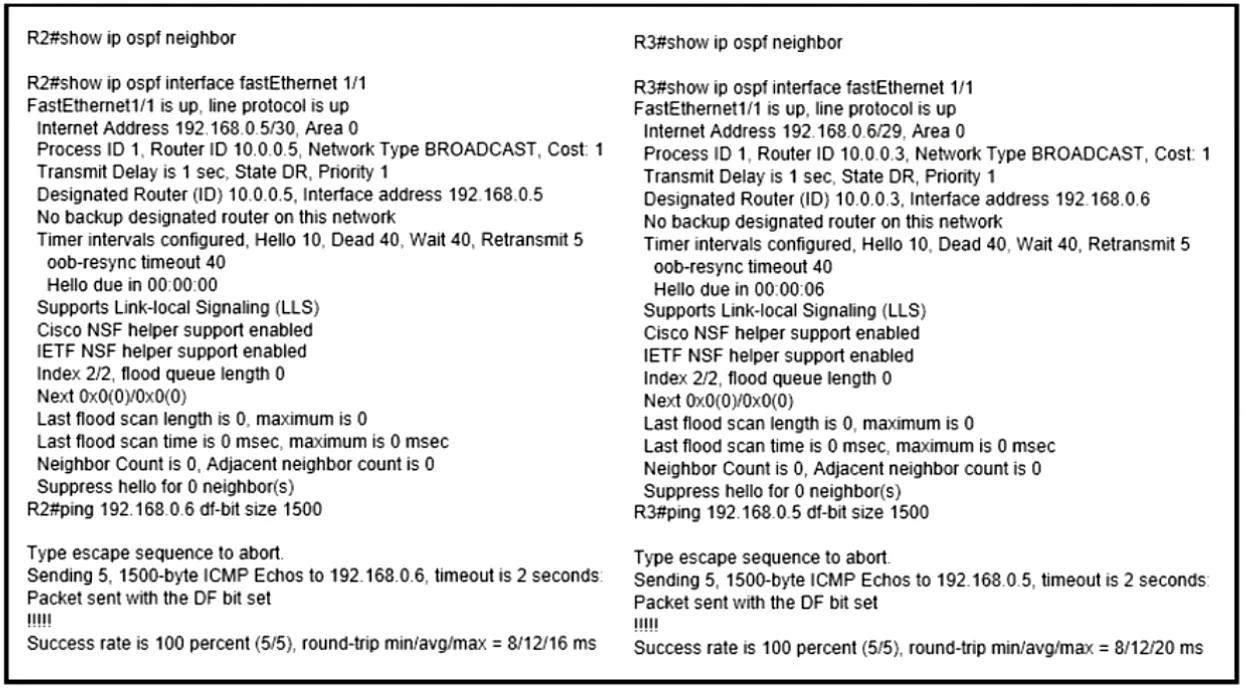
Refer to the exhibit. Why does the OSPF neighborship fail between the two interfaces?
The correct answer is D. The IP subnet mask is not the same. The OSPF neighborship fails because the IP subnet masks configured on the two interfaces are not identical, preventing them from recognizing each other as being on the same network segment.
Question
Exhibits
Options
- AThe MTU is not the same.
- BThe OSPF timers are different.
- CThere is a mismatch in the OSPF interface network type.
- DThe IP subnet mask is not the same.
How the community answered
(16 responses)- A6% (1)
- B31% (5)
- C13% (2)
- D50% (8)
Why each option
The OSPF neighborship fails because the IP subnet masks configured on the two interfaces are not identical, preventing them from recognizing each other as being on the same network segment.
While an MTU mismatch can cause OSPF neighborship issues (stuck in EXSTART/EXCHANGE), it typically manifests after the initial IP connectivity check, and is not as fundamental as a subnet mismatch.
Different OSPF timers (Hello/Dead) can prevent neighborship from forming or cause it to drop, but usually only after initial communication, and it's a separate check from the fundamental IP subnet match.
An OSPF interface network type mismatch (e.g., point-to-point vs. broadcast) can cause issues, but a subnet mismatch is a more direct and fundamental layer 3 connectivity problem that precedes network type considerations.
For OSPF routers to establish a neighborship, they must be on the same IP subnet. If the IP subnet masks configured on the interfaces are different, even if the IP addresses appear to be in the same range, the routers will not recognize each other as being in the same broadcast domain, which is a fundamental requirement for OSPF adjacency formation.
Concept tested: OSPF neighborship requirements (IP subnet)
Source: https://www.cisco.com/c/en/us/support/docs/ip/open-shortest-path-first-ospf/13689-1.html
Topics
Community Discussion
No community discussion yet for this question.