
350-401 · Question #82
Which EIGRP feature allows the use of leak maps?
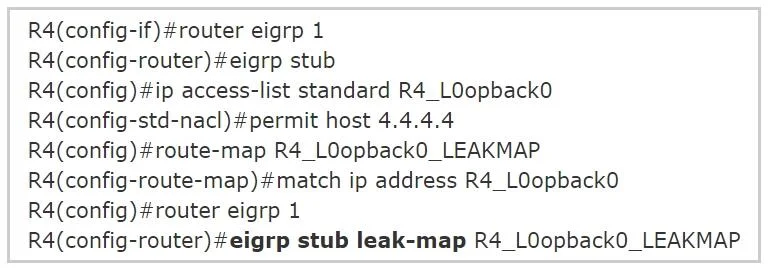
The correct answer is D. stub. EIGRP Stub and Leak Maps D (stub) is correct because the EIGRP stub feature uses leak maps to selectively advertise specific routes that would otherwise be suppressed by the stub configuration. A stub router normally limits the routes it advertises (e.g., connected, summary)…
Question
Which EIGRP feature allows the use of leak maps?
Exhibit
Options
- Aoffset-list
- Bneighbor
- Caddress-family
- Dstub
How the community answered
(65 responses)- A3% (2)
- B6% (4)
- C2% (1)
- D89% (58)
Explanation
EIGRP Stub and Leak Maps
D (stub) is correct because the EIGRP stub feature uses leak maps to selectively advertise specific routes that would otherwise be suppressed by the stub configuration. A stub router normally limits the routes it advertises (e.g., connected, summary), but a leak map - a route map tied to the stub command - allows certain prefixes to "leak" through and be advertised as exceptions to the stub restrictions.
Option A (offset-list) is wrong because offset-lists are used to adjust EIGRP metric values (delay or bandwidth), not to control route advertisement exceptions. Option B (neighbor) defines static EIGRP neighbors for unicast peering and has no relationship to leak maps. Option C (address-family) is a configuration container used in EIGRP named mode to organize routing configuration by address type, but it is not the feature that enables leak maps - the stub command within the address-family does that.
Memory Tip: Think of "stub + leak map" as a dam with a controlled release valve - the stub blocks most route advertisements, and the leak map is the valve that lets specific routes flow through. "Stubborn routes need a leak to escape!"
Topics
Community Discussion
No community discussion yet for this question.