
350-401 · Question #723
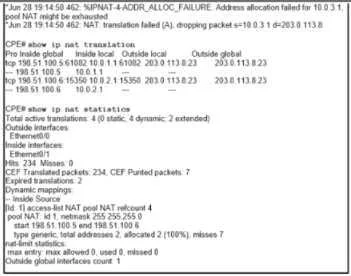
Refer to the exhibit. An administrator troubleshoots intermittent connectivity from internal hosts to an external public server. Some internal hosts can connect to the server while others receive an…
The correct answer is A. The translation does not use address overloading. Intermittent connectivity and 'Host Unreachable' messages for some internal hosts accessing external resources typically indicate that Network Address Translation (NAT) is not using overloading, leading to an exhaustion of available public IP addresses.
Question
Exhibits
Options
- AThe translation does not use address overloading.
- BThe NAT ACL does not match alt internal hosts
- CThe NAT ACL and NAT pool share the same name
- DThe NAT pool netmask is excessively wide.
How the community answered
(51 responses)- A55% (28)
- B8% (4)
- C16% (8)
- D22% (11)
Why each option
Intermittent connectivity and 'Host Unreachable' messages for some internal hosts accessing external resources typically indicate that Network Address Translation (NAT) is not using overloading, leading to an exhaustion of available public IP addresses.
If NAT is configured without overloading (PAT), each internal host uses a unique IP address from the NAT pool; when the limited pool is exhausted by concurrent connections, new connections from other hosts fail with 'Host Unreachable' errors, causing intermittent connectivity.
If the NAT ACL did not match all internal hosts, the unmatched hosts would consistently fail to connect, not intermittently.
Having the NAT ACL and NAT pool share the same name is a valid configuration and does not cause functional issues or intermittent connectivity.
An excessively wide NAT pool netmask would increase the number of available IP addresses, making address exhaustion less likely, not causing it.
Concept tested: NAT overloading (PAT) and address exhaustion
Source: https://www.cisco.com/c/en/us/td/docs/ios/nat/configuration/guide/nat_c.html
Topics
Community Discussion
No community discussion yet for this question.