
350-401 · Question #699
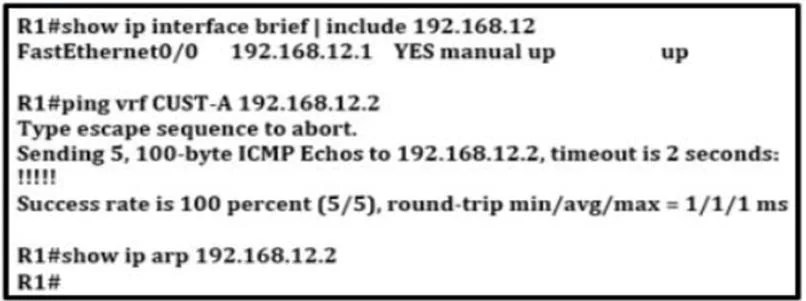
Refer to the exhibit. A network engineer checks connectivity between two routers. The engineer can ping the remote endpoint but cannot see an ARP entry. Why is there no ARP entry?
The correct answer is B. Interface FastEthernet0/0 Is configured in VRF CUST-A, so the ARP entry is also in that VRF. When an interface is part of a Virtual Routing and Forwarding (VRF) instance, its associated ARP entries are isolated to that specific VRF, preventing them from appearing in the global ARP table.
Question
Refer to the exhibit. A network engineer checks connectivity between two routers. The engineer can ping the remote endpoint but cannot see an ARP entry. Why is there no ARP entry?
Exhibits
Options
- AThe ping command must be executed in the global routing table.
- BInterface FastEthernet0/0 Is configured in VRF CUST-A, so the ARP entry is also in that VRF.
- CWhen VRFs are used. ARP protocol must be enabled In each VRF.
- DWhen VRFs are used. ARP protocol is disabled in the global routing table.
How the community answered
(53 responses)- A19% (10)
- B64% (34)
- C6% (3)
- D11% (6)
Why each option
When an interface is part of a Virtual Routing and Forwarding (VRF) instance, its associated ARP entries are isolated to that specific VRF, preventing them from appearing in the global ARP table.
The ping command can be executed successfully within a VRF context; the issue is with the visibility of the ARP entry in the global table, not the command's execution itself.
Virtual Routing and Forwarding (VRF) instances create isolated routing and forwarding tables on a single router. If FastEthernet0/0 is configured within VRF CUST-A, all network operations, including the Address Resolution Protocol (ARP) table, are logically separated and belong exclusively to that VRF, hence the ARP entry would only be discoverable within the CUST-A VRF context.
ARP protocol is a fundamental aspect of IP communication on a local segment and functions automatically within each VRF without requiring explicit enabling per VRF.
The ARP protocol is not disabled in the global routing table when VRFs are used; it continues to operate normally for interfaces assigned to the global routing table.
Concept tested: VRF ARP table isolation
Source: https://www.cisco.com/c/en/us/td/docs/ios-xml/ios/ipapp_vrf/configuration/15-mt/ivr-15-mt-book/ivr-cfg.html
Topics
Community Discussion
No community discussion yet for this question.