
350-401 · Question #644
Which benefit is realized by implementing SSO?
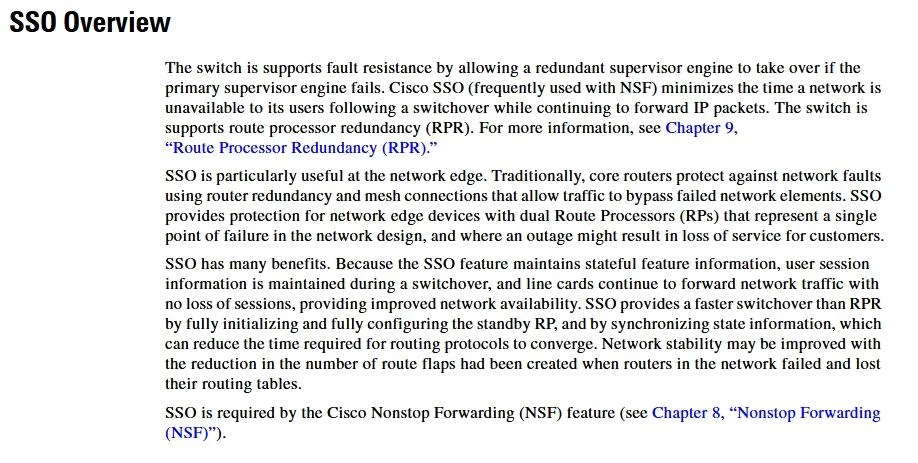
The correct answer is D. minimal network downtime following an RP switchover. Implementing Stateful Switchover (SSO) on redundant route processors provides high availability by ensuring minimal network downtime during a route processor (RP) switchover.
Question
Exhibit
Options
- AIP first-hop redundancy
- Bcommunication between different nodes for cluster setup
- Cphysical link redundancy
- Dminimal network downtime following an RP switchover
How the community answered
(39 responses)- A3% (1)
- B5% (2)
- C3% (1)
- D90% (35)
Why each option
Implementing Stateful Switchover (SSO) on redundant route processors provides high availability by ensuring minimal network downtime during a route processor (RP) switchover.
SSO does not directly provide IP first-hop redundancy; that is a function of protocols like HSRP, VRRP, or GLBP.
SSO's primary benefit is not about communication between different nodes for cluster setup, but rather maintaining stateful information during an RP switchover within a single device.
Physical link redundancy is achieved through etherchannels or redundant physical cabling, not directly by SSO.
Stateful Switchover (SSO) is a Cisco IOS feature designed to provide high availability by enabling a standby Route Processor (RP) to take over from a failed active RP seamlessly. This process allows the forwarding plane to continue operating, thereby minimizing network downtime and maintaining network stability during an RP failure.
Concept tested: Stateful Switchover (SSO) benefits
Source: https://www.cisco.com/c/en/us/td/docs/ios-xml/ios/ha/configuration/15-mt/ha-15-mt-book/ha-sso-overview.html
Topics
Community Discussion
No community discussion yet for this question.