
350-401 · Question #589
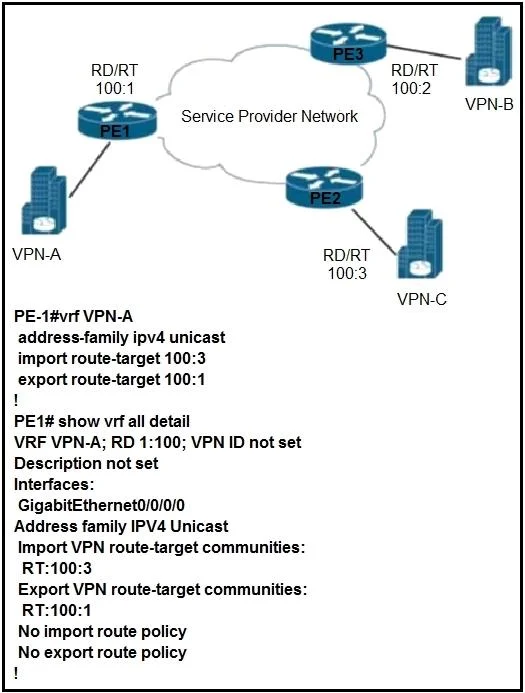
Refer to the exhibit. VPN-A sends point-to-point traffic to VPN-B and receives traffic only from VPN-C. VPN-B sends point-to-point traffic to VPN-C and receives traffic only from VPN-A. Which…
The correct answer is D. PE-3. Hub-and-Spoke VPN Traffic Flow Explanation Option D (PE-3) is correct because the described traffic pattern represents a hub-and-spoke MPLS VPN topology, where PE-3 acts as the hub PE router. In this design, VPN-A can send to VPN-B, VPN-B can send to VPN-C, and each VPN only…
Question
Exhibits
Options
- APE-2
- BPE-3
- CPE-2
- DPE-3
How the community answered
(48 responses)- A2% (1)
- B8% (4)
- C6% (3)
- D83% (40)
Explanation
Hub-and-Spoke VPN Traffic Flow Explanation
Option D (PE-3) is correct because the described traffic pattern represents a hub-and-spoke MPLS VPN topology, where PE-3 acts as the hub PE router. In this design, VPN-A can send to VPN-B, VPN-B can send to VPN-C, and each VPN only receives from a specific peer - this asymmetric, unidirectional flow is enforced through separate import/export Route Target (RT) policies configured on the hub PE (PE-3), which controls the redistribution of routes between the spoke sites.
Options A and C (both referencing PE-2) are incorrect because PE-2 would be a spoke PE router in this topology, meaning it connects to individual VPN sites but does not control the inter-VPN routing policy that governs which sites can send/receive traffic from one another. Spoke PEs simply apply standard RT import/export without the complex redistribution logic needed to enforce this directional traffic flow.
Memory Tip: Think of the hub PE as the "traffic cop" - it sits in the middle and directs who can talk to whom using asymmetric Route Targets. If the question describes controlled, unidirectional traffic between multiple VPNs, the answer is always the hub (central) PE, not a spoke PE.
Topics
Community Discussion
No community discussion yet for this question.