
350-401 · Question #219
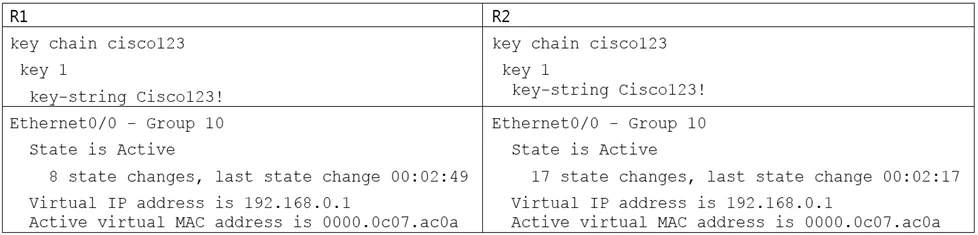
Refer to the exhibit. An engineer is installing a new pair of routers in a redundant configuration. Which protocol ensures that traffic is not disrupted in the event of a hardware failure?
The correct answer is A. HSRPv1. Explanation HSRPv1 (Hot Standby Router Protocol version 1) is a Cisco-proprietary First Hop Redundancy Protocol (FHRP) that creates a virtual IP and MAC address shared between two routers, ensuring seamless failover if the active router experiences a hardware failure - making…
Question
Refer to the exhibit. An engineer is installing a new pair of routers in a redundant configuration. Which protocol ensures that traffic is not disrupted in the event of a hardware failure?
Exhibits
Options
- AHSRPv1
- BGLBP
- CVRRP
- DHSRPv2
How the community answered
(36 responses)- A89% (32)
- B3% (1)
- C3% (1)
- D6% (2)
Explanation
Explanation
HSRPv1 (Hot Standby Router Protocol version 1) is a Cisco-proprietary First Hop Redundancy Protocol (FHRP) that creates a virtual IP and MAC address shared between two routers, ensuring seamless failover if the active router experiences a hardware failure - making it the classic answer for basic redundant router pair configurations in Cisco environments. GLBP (Choice B) is incorrect because, while it also provides redundancy, it additionally performs load balancing across multiple gateways, making it more than what a simple redundant pair requires. VRRP (Choice C) is incorrect because it is an open-standard protocol (not Cisco-proprietary), and exam questions featuring Cisco routers in a redundant pair typically point toward an HSRP solution. HSRPv2 (Choice D) extends HSRPv1 with support for IPv6, millisecond timers, and a larger group range, but the question's context of a basic redundant pair with no IPv6 requirement points to the simpler HSRPv1.
Memory Tip: Think "HSRP = Hot Standby = Hardware failure backup" - when you see a simple two-router redundant pair on a Cisco exam, default to HSRPv1 unless IPv6 or load balancing is specifically mentioned.
Topics
Community Discussion
No community discussion yet for this question.