
350-401 · Question #1307
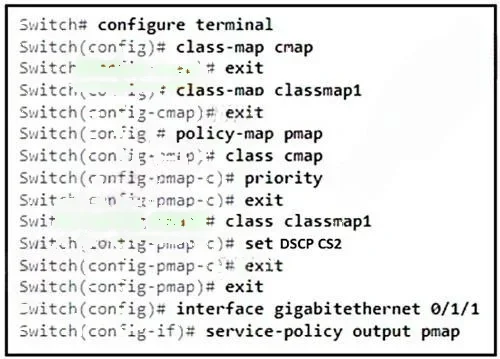
Refer to the exhibit. An engineer receives an error when applying low latency queuing on a new switch. What is causing this policy to fail?
The correct answer is D. Low latency queuing needs to be applied inbound. Low latency queuing (LLQ) policies are fundamentally designed for traffic shaping and prioritization on the outbound direction of an interface, and attempting to apply them inbound will typically result in a configuration error.
Question
Refer to the exhibit. An engineer receives an error when applying low latency queuing on a new switch. What is causing this policy to fail?
Exhibits
Options
- AThere is no bandwidth rate applied for the priority queue.
- BThere is no action after the set statement.
- CTraffic marking should be completed on a different policy
- DLow latency queuing needs to be applied inbound
How the community answered
(36 responses)- A19% (7)
- B6% (2)
- C8% (3)
- D67% (24)
Why each option
Low latency queuing (LLQ) policies are fundamentally designed for traffic shaping and prioritization on the outbound direction of an interface, and attempting to apply them inbound will typically result in a configuration error.
While a 'priority' queue can optionally have a 'bandwidth' limit, its absence does not typically cause the entire LLQ policy to fail upon application; it simply means the priority queue has no explicit rate limit.
A 'set' statement within a policy map does not necessarily require an immediate subsequent action; its purpose is usually to mark traffic, which can be an endpoint action for a class.
While traffic marking can be performed in a separate policy or on an ingress interface, this is a design choice and not a reason for an LLQ policy to fail upon application.
Low latency queuing (LLQ) is primarily an egress QoS feature, meaning it must be applied on the outbound direction of an interface ('service-policy output') to correctly prioritize and queue traffic as it leaves the device. Applying it inbound ('service-policy input') will result in an error or incorrect behavior because queuing decisions are made on transmission.
Concept tested: QoS policy application direction
Source: https://www.cisco.com/c/en/us/td/docs/ios/qos/configuration/guide/qos_c/qoscovw.html
Topics
Community Discussion
No community discussion yet for this question.