
350-401 · Question #1197
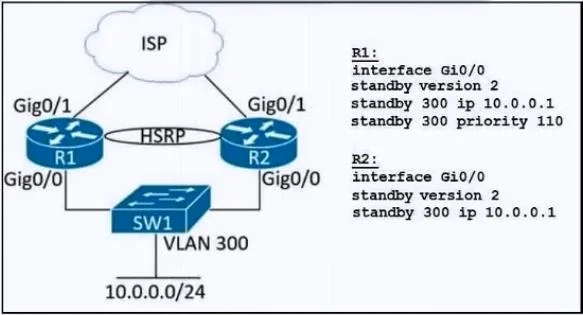
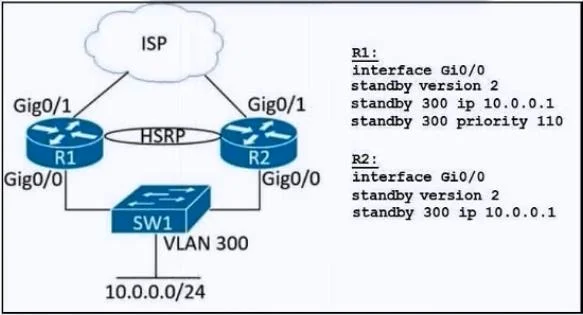
Refer to the exhibit. An engineer must implement HSRP between two WAN routers. In the event R1 fails and then regains operational status, it must allow 100 seconds for the routing protocol to…
The correct answer is B. R1. HSRP Preemption with Delay Configuration Option B is correct because it configures HSRP preemption on R1 with a reload delay of 100 seconds (standby 1 preempt delay reload 100), which ensures that when R1 recovers from a failure, it waits 100 seconds before reclaiming the…
Question
Refer to the exhibit. An engineer must implement HSRP between two WAN routers. In the event R1 fails and then regains operational status, it must allow 100 seconds for the routing protocol to converge before preemption takes effect. Which configuration is required?
Exhibits
Options
- AR2
- BR1
- CR1
- DR1
How the community answered
(26 responses)- A8% (2)
- B73% (19)
- C15% (4)
- D4% (1)
Explanation
HSRP Preemption with Delay Configuration
Option B is correct because it configures HSRP preemption on R1 with a reload delay of 100 seconds (standby 1 preempt delay reload 100), which ensures that when R1 recovers from a failure, it waits 100 seconds before reclaiming the active HSRP role - giving routing protocols time to fully converge before traffic is forwarded through R1.
Since the exhibit is not visible here, the distractors (A, C, and D) likely represent incorrect configurations such as: applying the preempt delay on R2 instead of R1 (wrong router - R2 is the standby, not the one that needs to reclaim the active role), using incorrect delay timer syntax like minimum instead of reload, or omitting the delay altogether with a plain standby 1 preempt command (which causes immediate preemption, risking a black hole before routing converges).
Memory Tip: Think of it this way - the Active router (R1) needs the delay, because it's the one coming back. Use the phrase "RELOAD = Router Existing Online After Downtime" to remember that delay reload is the correct keyword when the concern is a device recovering from a restart or failure. Always apply preempt delay on the higher-priority router that will reclaim the active role.
Topics
Community Discussion
No community discussion yet for this question.