
350-401 · Question #119
Refer to the exhibit. A port channel is configured between SW2 and SW3. SW2 is not running a Cisco operating system. When all physical connections are mode, the port channel does not establish…
The correct answer is A. The port channel on SW2 is using an incompatible protocol. Explanation Option A is correct because SW3 is configured with LACP (Link Aggregation Control Protocol), indicated by the channel-group X mode active command, which is a Cisco-supported open standard (IEEE 802.3ad). However, since SW2 is not running a Cisco OS, it cannot use…
Question
Refer to the exhibit. A port channel is configured between SW2 and SW3. SW2 is not running a Cisco operating system. When all physical connections are mode, the port channel does not establish. Based on the configuration excerpt of SW3, what is the cause of the problem?
Exhibits
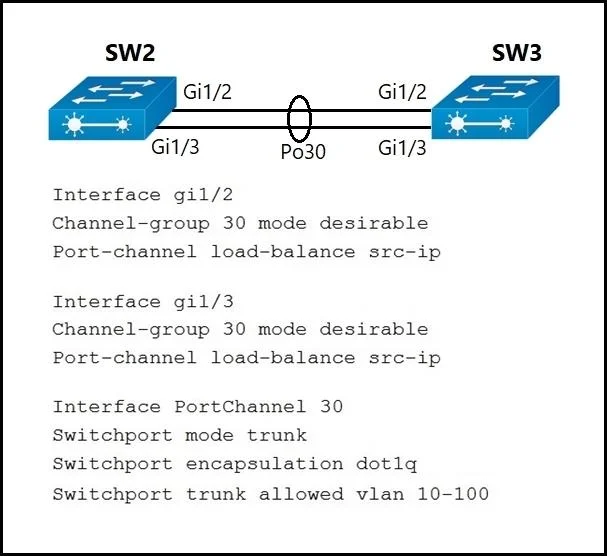
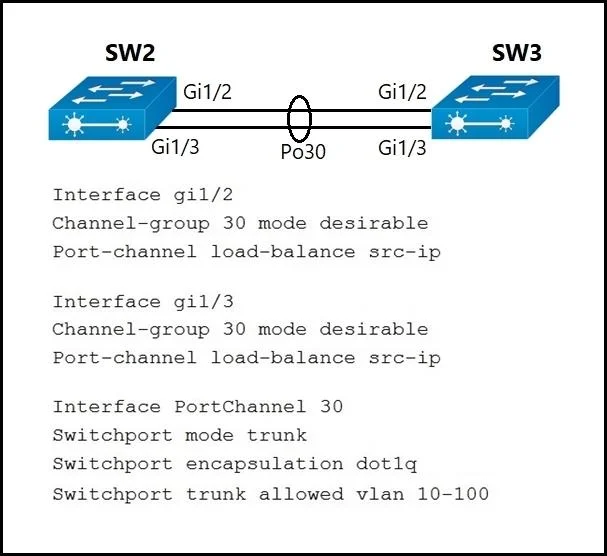
Options
- AThe port channel on SW2 is using an incompatible protocol.
- BThe port-channel trunk is not allowing the native VLAN.
- CThe port-channel should be set to auto.
- DThe port-channel interface lead balance should be set to src-mac
How the community answered
(64 responses)- A70% (45)
- B9% (6)
- C5% (3)
- D16% (10)
Explanation
Explanation
Option A is correct because SW3 is configured with LACP (Link Aggregation Control Protocol), indicated by the channel-group X mode active command, which is a Cisco-supported open standard (IEEE 802.3ad). However, since SW2 is not running a Cisco OS, it cannot use PAgP (Port Aggregation Protocol), which is Cisco-proprietary - meaning both switches must agree on using LACP, and if SW2 is configured with PAgP or a static/incompatible mode, the port channel will fail to negotiate.
- Option B is wrong because native VLAN configuration affects traffic tagging behavior, not port channel establishment itself.
- Option C is wrong because setting the port channel to
autois a PAgP passive mode - using a Cisco-proprietary protocol would make things worse with a non-Cisco switch, not better. - Option D is wrong because load balancing method (src-mac, dst-ip, etc.) affects traffic distribution across links and has no bearing on whether the port channel establishes.
Memory Tip: Think "Non-Cisco = LACP only" - PAgP is Cisco's private party, and non-Cisco switches aren't on the guest list. Always use LACP (
mode active/passive) in multi-vendor environments.
Topics
Community Discussion
No community discussion yet for this question.