
350-401 · Question #1157
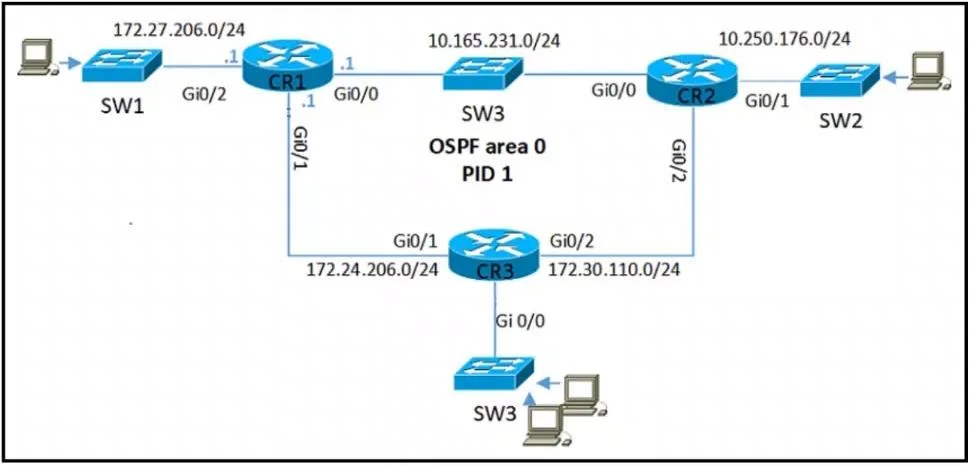
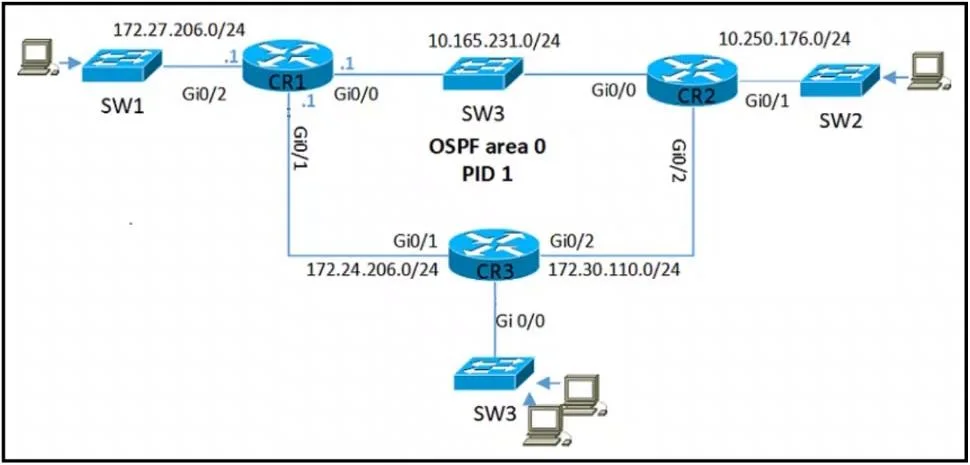
Refer to the exhibit. CR2 and CR3 are configured with OSPF. Which configuration, when applied to CR1, allows CR1 to exchange OSPF information with CR2 and CR3 but not with other network devices or…
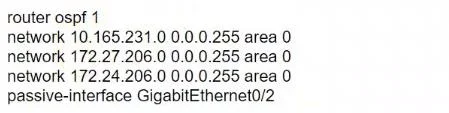
The correct answer is B. router ospf 1 network 10.165.231.0 0.0.0.255 area 0 network 172.27.206.0 0.0.0.255 area 0 network 172.24.206.0 0.0.0.255 area 0 passive-interface GigabitEthernet0/2. Option B is correct because it uses precise wildcard masks (0.0.0.255) that exactly match only the three specific /24 subnets connecting CR1 to CR2 and CR3 - meaning any new interface added to CR1 will not automatically participate in OSPF unless a matching network statement is…
Question
Exhibits
Options
- Arouter ospf 1 network 10.0.0.0 255.255.255.255 area 0 passive-interface GigabitEthernet0/2
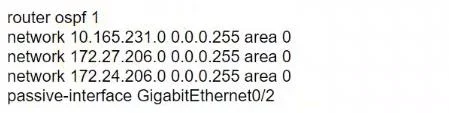
- Brouter ospf 1 network 10.165.231.0 0.0.0.255 area 0 network 172.27.206.0 0.0.0.255 area 0 network 172.24.206.0 0.0.0.255 area 0 passive-interface GigabitEthernet0/2
- Cinterface Gi0/2 ip ospf 1 area 0 router ospf 1 passive-interface GigabitEthernet0/2
- Drouter ospf 1 network 10.0.0.0 0.0.0.255.255 area 0 network 172.16.0.0 0.15.255.255 area 0 passive-interface GigabitEthernet0/2
How the community answered
(51 responses)- A2% (1)
- B80% (41)
- C12% (6)
- D6% (3)
Explanation
Option B is correct because it uses precise wildcard masks (0.0.0.255) that exactly match only the three specific /24 subnets connecting CR1 to CR2 and CR3 - meaning any new interface added to CR1 will not automatically participate in OSPF unless a matching network statement is explicitly added. The passive-interface GigabitEthernet0/2 suppresses OSPF hellos on that interface without removing it from the routing table.
Option A is wrong because the wildcard mask 255.255.255.255 means "match any address," which would enable OSPF on all interfaces - the opposite of the desired restriction.
Option C is wrong because it applies ip ospf 1 area 0 on Gi0/2 and then immediately makes it passive (self-contradictory), and it never enables OSPF on the interfaces actually connecting to CR2 and CR3.
Option D is wrong because the summary wildcard masks (e.g., 0.15.255.255) are overly broad - they encompass large address ranges and would inadvertently activate OSPF on any new interface whose IP falls within those ranges.
Memory tip: Think "OSPF wildcard = precision scope." The more specific your wildcard mask, the fewer interfaces OSPF can "accidentally" activate on - if you want tight control, use exact subnet wildcards (0.0.0.255 for /24s) rather than broad summaries or all-ones wildcards.
Topics
Community Discussion
No community discussion yet for this question.