
350-001 · Question #174
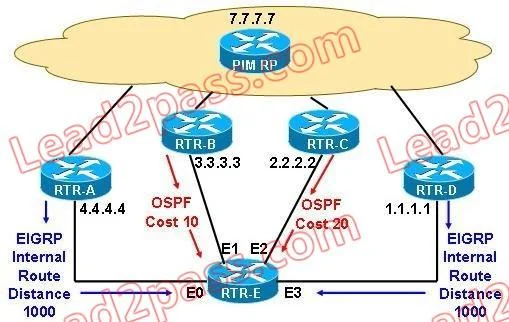
Refer to the exhibit. Router E learned about the PIM RP (designated as 7.7.7.7) from four different sources. Routers A and D advertised the 7.0.0.0 network via EIGRP. Routers B and C advertised the…
The correct answer is A. E0. PIM will use the neighbor with the highest IP. E0 and E3 is taken in to account as EIGRP has lower AD the OSPF, if both E0 and E3 cost are the same next there is rule that "When faced with multiple equal cost paths to a source, IP multicast chooses the interface that has a…
Question
Refer to the exhibit. Router E learned about the PIM RP (designated as 7.7.7.7) from four different sources. Routers A and D advertised the 7.0.0.0 network via EIGRP. Routers B and C advertised the 7.0.0.0 network via OSPF. Considering that all four Ethernet interfaces on router E could potentially lead back to the PIM-RP, when router E receives the first multicast packet down the shared tree, which incoming interface will be used to successfully pass the RPF check?
Exhibit
Options
- AE0
- BE1
- CE2
- DE3
- ENone of these interfaces will be used to successfully pass the RPF check.
- FAll of these interfaces would successfully pass the RPF check.
How the community answered
(20 responses)- A55% (11)
- B15% (3)
- C5% (1)
- D5% (1)
- E20% (4)
Explanation
PIM will use the neighbor with the highest IP. E0 and E3 is taken in to account as EIGRP has lower AD the OSPF, if both E0 and E3 cost are the same next there is rule that "When faced with multiple equal cost paths to a source, IP multicast chooses the interface that has a Protocol Independent Multicast (PIM) neighbor with the highest IP address as the incoming interface and then sends prunes to PIM neighbors on the other links."
Topics
Community Discussion
No community discussion yet for this question.