
350-001 · Question #12
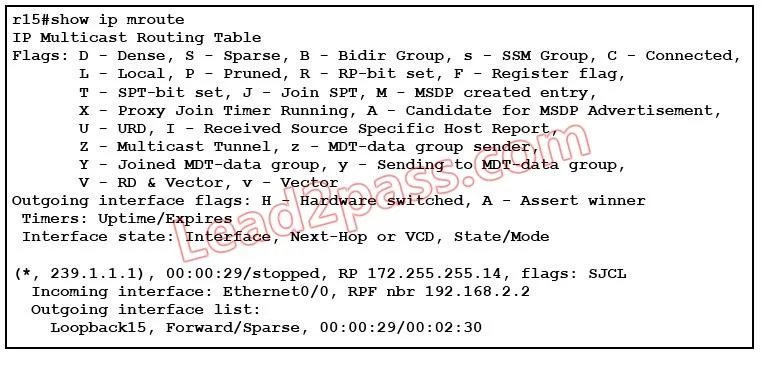
Refer to the exhibit. What does the incoming interface of the above (*,G) entry indicate?
The correct answer is E. the interface closest to the RP, according to the unicast routing table. A source tree is the simplest form of distribution tree. The source host of the multicast traffic is located at the root of the tree, and the receivers are located at the ends of the branches. Multicast traffic travels from the source host down the tree toward the receivers…
Question
Refer to the exhibit. What does the incoming interface of the above (*,G) entry indicate?
Exhibit
Options
- Athe interface closest to the source, according to the unicast routing table
- Bthe interface where an IGMP join has been received
- Cthe interface with the highest IP address
- Dthe last interface to hear a PIM (*,G) join
- Ethe interface closest to the RP, according to the unicast routing table
How the community answered
(34 responses)- A6% (2)
- B3% (1)
- C12% (4)
- D3% (1)
- E76% (26)
Explanation
A source tree is the simplest form of distribution tree. The source host of the multicast traffic is located at the root of the tree, and the receivers are located at the ends of the branches. Multicast traffic travels from the source host down the tree toward the receivers. The forwarding decision on which interface a multicast packet should be transmitted out is based on the multicast forwarding table. This table consists of a series of multicast state entries that are cached in the router. State entries for a source tree use the notation (S, G) pronounced S comma G. The letters represents the IP address of the source, and G represents the group address. Shared trees differ from source trees in that the root of the tree is a common point somewhere in This common point is referred to as the rendezvous point (RP). The RP is the point at which receivers join to learn of active sources. Multicast sources must transmit their traffic to the RP. When receivers join a multicast group on a shared tree, the root of the tree is always the RP, and multicast traffic is transmitted from the RP down toward the receivers. Therefore, the RP acts as a go-between for the sources and receivers. An RP can be the root for all multicast groups in the network, or different ranges of multicast groups can be associated with different RPs. Multicast forwarding entries for a shared tree use the notation (, G), which is pronounced star comma G. This is because all sources for a particular group share the same tree. (The multicast groups go to the same RP.) Therefore, the * or wildcard represents all sources. Additional Information from Microsoft Multicast traffic from source 162.10.4.1 (for example) uses the RPT, meaning the source sends it to the RP rather than to the multicast group (the router would denote this by having a (, G) entry rather than a (S, G) entry). Before sending this traffic, Router 1 checks its unicast routing table to see if packets from the RP are arriving on the correct interface. In this case they are, because they arrive on interface I1, and the packets are forwarded.
Topics
Community Discussion
No community discussion yet for this question.