
350-001 · Question #176
Refer to the exhibit. Two ISPs have decided to use MSDP and configured routers X and Y (both are PIM RPs) as MSDP peers. In the domain of ISP B, PC A has sent an IGMP membership report for the group…
The correct answer is A. Router X will contain an entry for 224.1.1.1 in its SA cache and will also have an installed (S, G) D. Router X will not contain an entry for 224.5.5.5 in its SA cache but will have an installed (*, G). Configuring an MSDP Peer You enable MSDP by configuring an MSDP peer to the local router. The router you specify by Domain Naming System (DNS) name or IP address as an MSDP peer is probably a Border Gateway Protocol (BGP) neighbor. If it is not, see the section "Configuring a…
Question
Refer to the exhibit. Two ISPs have decided to use MSDP and configured routers X and Y (both are PIM RPs) as MSDP peers. In the domain of ISP B, PC A has sent an IGMP membership report for the group 224.1.1.1 and PC B has sent an IGMP membership report for the group 224.5.5.5. Assuming that the MSDP peering relationship between routers X and Y is functional, and given the partial configuration output shown from router X, which two of these statements are true? (Choose two.)
Exhibit
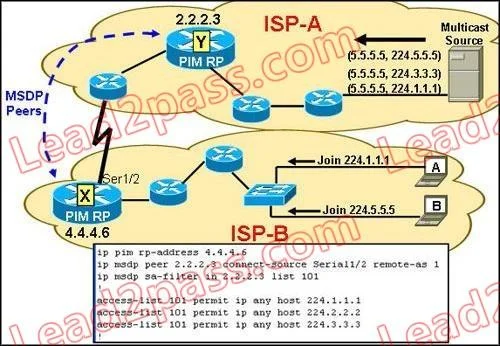
Options
- ARouter X will contain an entry for 224.1.1.1 in its SA cache and will also have an installed (S, G)
- BRouter X will not contain an entry for 224.1.1.1 in its SA cache but will have an installed (*, G)
- CRouter X will not contain an entry for 224.5.5.5 in its SA cache but will have an installed (S, G)
- DRouter X will not contain an entry for 224.5.5.5 in its SA cache but will have an installed (*, G)
- ERouter X will have no entries for 224.5.5.5 in neither its SA cache nor in its mroute table.
- FRouter X will have no entries for 224.1.1.1 in neither its SA cache nor in its mroute table.
How the community answered
(30 responses)- A57% (17)
- B23% (7)
- C7% (2)
- E3% (1)
- F10% (3)
Explanation
Configuring an MSDP Peer You enable MSDP by configuring an MSDP peer to the local router. The router you specify by Domain Naming System (DNS) name or IP address as an MSDP peer is probably a Border Gateway Protocol (BGP) neighbor. If it is not, see the section "Configuring a Default MSDP Peer" later in this document. To configure an MSDP peer, use the following commands in global configuration mode as The second command is optional. Filtering SA Request Messages By default, only routers that are caching SA information can respond to SA request messages. By default, such a router honors all SA request messages from its MSDP peers. That is, it will supply the IP addresses of the sources that are active. However, you can configure the router to ignore all SA request messages from an MSDP peer. Or, you can honor only those SA request messages from a peer for groups described by a standard access list. If the access list passes, SA request messages will be accepted. All other such messages from the peer for other groups will be ignored. To configure one of these options, use either of the following commands in global configuration s_Configuration_Guide_Chapter.html#wp1001055
Topics
Community Discussion
No community discussion yet for this question.