
300-610 · Question #293
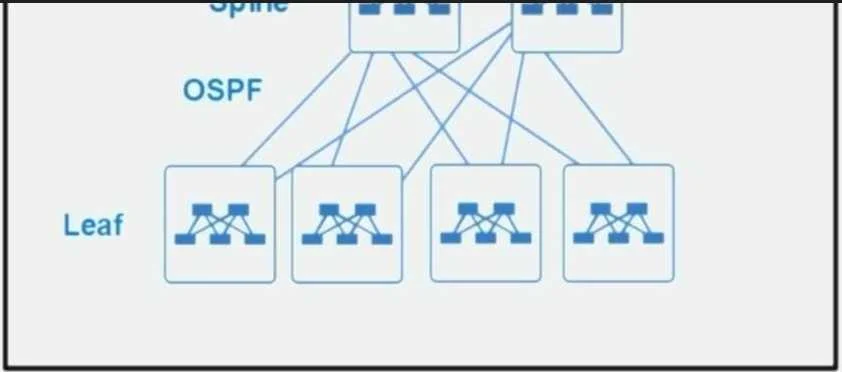
Refer to the exhibit. Fiber links are provisioned directly between the spine and leaf switches in the given LAN topology. A /30 prefix has been configured over each fiber link to provide underlay…
The correct answer is B. Enable BFD on the /30 links. To ensure the shortest possible convergence time in a VXLAN underlay network when a direct fiber link between spine and leaf switches is cut, the network-engineering team must enable Bidirectional Forwarding Detection (BFD) on the /30 links.
Question
Refer to the exhibit. Fiber links are provisioned directly between the spine and leaf switches in the given LAN topology. A /30 prefix has been configured over each fiber link to provide underlay connectivity for a VXLAN network. The network-engineering team must update the network configuration to provide the shortest possible convergence time if a fiber link is cut. Which action must the team take to meet the requirement?
Exhibit
Options
- AConfigure the /30 links as OSPF point-to-point networks
- BEnable BFD on the /30 links
- CEnable UDLD on the G0 links
- DConfigure ECMP on the /30 links
How the community answered
(40 responses)- A8% (3)
- B85% (34)
- C3% (1)
- D5% (2)
Why each option
To ensure the shortest possible convergence time in a VXLAN underlay network when a direct fiber link between spine and leaf switches is cut, the network-engineering team must enable Bidirectional Forwarding Detection (BFD) on the /30 links.
Configuring /30 links as OSPF point-to-point networks is standard for underlay routing but does not inherently provide the shortest possible convergence time for link failures without additional mechanisms like BFD.
Enabling Bidirectional Forwarding Detection (BFD) on the /30 links is the most effective action to achieve the shortest possible convergence time when a fiber link is cut. BFD is a lightweight protocol that provides rapid fault detection for forwarding paths (in milliseconds), allowing routing protocols (like OSPF or BGP) to be notified of a link failure almost instantly, leading to significantly faster convergence than relying solely on default hello timers.
UDLD (UniDirectional Link Detection) helps detect unidirectional links and prevent network issues but does not directly accelerate convergence time for link down events in the same way BFD does for routing protocols.
Configuring ECMP (Equal-Cost Multipath) enables traffic distribution over multiple equal-cost paths, improving bandwidth and resilience, but it's a load-balancing mechanism and does not directly speed up the detection of a link failure on one of those paths.
Concept tested: VXLAN underlay fast convergence with BFD
Source: https://www.cisco.com/c/en/us/td/docs/iosxr/ce/routing/b-ce-routing-config-guide-xe-17-3-x/m-implementing-bfd.html
Topics
Community Discussion
No community discussion yet for this question.