
300-610 · Question #292
Refer to the exhibit. A Cisco engineer is planning a data migration job in heterogeneous SANs where the existing and new storage devices for the migration are already connected to the MDS switches…
The correct answer is B. Create two data migration jobs and add two storage ports in each job. To efficiently migrate data between heterogeneous SANs with active/active arrays and multiple LUN sets via Cisco MDS switches, the best approach is to create two data migration jobs, each utilizing two storage ports.
Question
Refer to the exhibit. A Cisco engineer is planning a data migration job in heterogeneous SANs where the existing and new storage devices for the migration are already connected to the MDS switches. All paths from the SSM to the storage-connected switch are going through the Cisco fabric. The setup is with active/active arrays and multiple LUN sets. What is the best approach to copy the LUN sets to the new location?
Exhibit
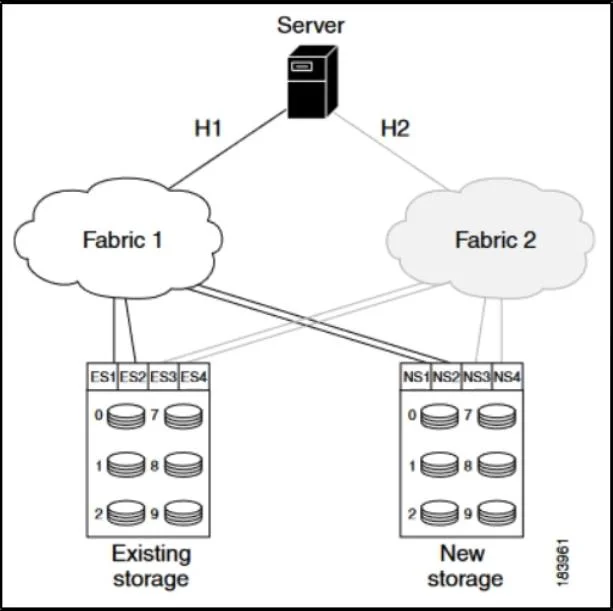
Options
- AAdd all paths Fabric-A zones to Fabric-B zones
- BCreate two data migration jobs and add two storage ports in each job
- CGrant access to all servers to the existing data sets
- DEnable synchronous replication for the new storage array
How the community answered
(40 responses)- A5% (2)
- B83% (33)
- C10% (4)
- D3% (1)
Why each option
To efficiently migrate data between heterogeneous SANs with active/active arrays and multiple LUN sets via Cisco MDS switches, the best approach is to create two data migration jobs, each utilizing two storage ports.
Adding all paths from Fabric-A zones to Fabric-B zones would create merged zones, which can lead to complex and potentially problematic SAN configurations and is not a direct method for performing data migration.
Creating two data migration jobs and adding two storage ports in each job (typically one from each fabric to each storage array controller) provides optimal performance and redundancy for data migration in heterogeneous SANs. This strategy allows for parallel data transfers, maximizing throughput and minimizing migration time by utilizing multiple available paths and controllers on the active/active arrays, while maintaining fabric separation and redundancy.
Granting access to all servers to the existing data sets is a prerequisite for server operation, not a data migration method to copy LUN sets to a new location.
Enabling synchronous replication for the new storage array is a feature of the storage array itself for disaster recovery or high availability, not a method to copy existing LUN sets from an older array in a heterogeneous migration scenario.
Concept tested: Cisco MDS SAN Data Migration Best Practices
Source: https://www.cisco.com/c/en/us/products/collateral/storage-networking/mds-9000-series-multilayer-switches/white_paper_c11-689363.html
Topics
Community Discussion
No community discussion yet for this question.