
300-610 · Question #337
Refer to the exhibit. Router R1 provides connectivity for DepartmentA. A network engineer must update R1 so that it also hosts DepartmentB. Traffic for DepartmentA and DepartmentB traffic must be…
The correct answer is C. Configure VRF-Lite for the DepartmentA VRF with default routes of 192.168.10.1 and. VRF-Lite provides traffic separation by placing DepartmentA and DepartmentB into different VRF instances on R1, giving each department an independent routing table. By configuring DepartmentB’s VRF with only a default route pointing to ISP-2 (192.168.20.1), DepartmentB is…
Question
Refer to the exhibit. Router R1 provides connectivity for DepartmentA. A network engineer must update R1 so that it also hosts DepartmentB. Traffic for DepartmentA and DepartmentB traffic must be separated, and DepartmentB must connect only via ISP-2. Which action must the engineer take on R1 to meet the requirements?
Exhibit
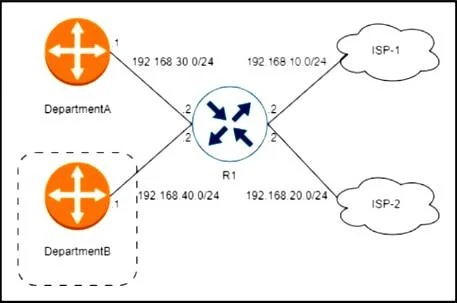
Options
- AConfigure DepartmentA and DepartmentB in separate VLANs with an ACL blocking the
- BConfigure separate routing protocols for DepartmentA and DepartmentB with the default route of
- CConfigure VRF-Lite for the DepartmentA VRF with default routes of 192.168.10.1 and
- DConfigure MPLS VPN with the default route of 192.168.20.1 for DepartmentB.
How the community answered
(17 responses)- A6% (1)
- B12% (2)
- C76% (13)
- D6% (1)
Explanation
VRF-Lite provides traffic separation by placing DepartmentA and DepartmentB into different VRF instances on R1, giving each department an independent routing table. By configuring DepartmentB’s VRF with only a default route pointing to ISP-2 (192.168.20.1), DepartmentB is forced to exit exclusively via ISP-2, while DepartmentA can retain its own default routing behavior
Topics
Community Discussion
No community discussion yet for this question.