
300-515 · Question #75
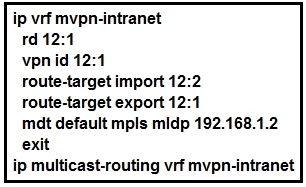
Refer to the exhibit. Which statement about this configuration is true?
The correct answer is A. Router 1 will accept multicast routes with a route-target of 12:1. Option A is correct because in MVPN configurations, import route-targets determine which BGP multicast routes a router will accept into its MVRF - the exhibit's configuration shows an import route-target of 12:1, meaning Router 1 will accept any multicast route tagged with that…
Question
Refer to the exhibit. Which statement about this configuration is true?
Exhibit
Options
- ARouter 1 will accept multicast routes with a route-target of 12:1.
- B192.168.1.2 must be reachable by all routers participating in the mvpn-intranet MVRF.
- CRouter 1 has statically defined thresholds for data MDT.
- DThe MVRF must be configured on each router on the customer and service provider networks.
How the community answered
(31 responses)- A52% (16)
- B13% (4)
- C29% (9)
- D6% (2)
Explanation
Option A is correct because in MVPN configurations, import route-targets determine which BGP multicast routes a router will accept into its MVRF - the exhibit's configuration shows an import route-target of 12:1, meaning Router 1 will accept any multicast route tagged with that value, just as with standard L3VPN BGP route-target logic.
Option B is wrong because the address referenced (192.168.1.2) is typically the default MDT group address, and only PE routers - not all routers on every participating network - need reachability to it; customer-side routers are unaffected.
Option C is incorrect because data MDT thresholds are configured explicitly with the mdt data command followed by a threshold value; if the exhibit shows only a default MDT statement without that command, no static data MDT thresholds are defined - the router uses defaults.
Option D is wrong because MVRF is only required on PE (Provider Edge) routers, not on every CE (customer) or P (core provider) router; those routers participate in the underlay or handle standard routing without needing VRF-aware multicast configuration.
Memory tip: Think of route-targets in MVPN exactly like regular L3VPN - import = accept inbound, export = advertise outbound. If you see an import RT in the config, that router accepts routes carrying that tag.
Topics
Community Discussion
No community discussion yet for this question.