
300-510 · Question #87
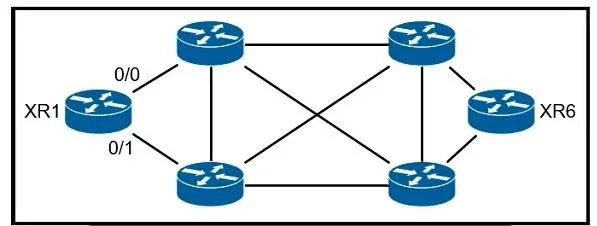
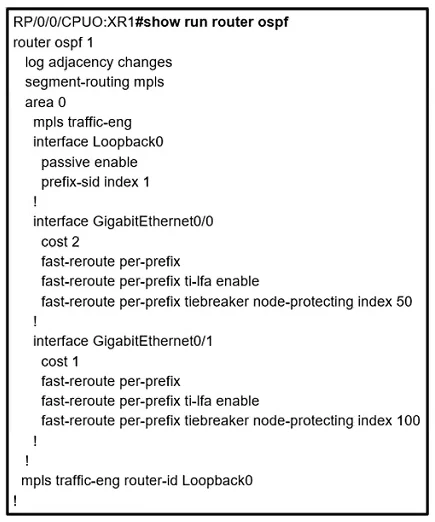
Refer to the exhibits. All links inside the network are configured at a default cost of one inside the fully converged OSPF domain. Given the configuration from XR1, which interface does traffic…
The correct answer is A. Interface GigabitElhemet 0/0. The tie breaker of the node index priority is lower and trumps the. When all OSPF links have equal cost (cost = 1), multiple equal-cost paths may exist to a destination. OSPF uses tie-breaking rules to select among equal-cost paths. In Cisco IOS XR with Segment Routing or standard OSPF ECMP, when path costs are equal, the tie-breaker mechanism…
Question
Refer to the exhibits. All links inside the network are configured at a default cost of one inside the fully converged OSPF domain. Given the configuration from XR1, which interface does traffic from XR1 that is destined to the loopback interface of XR6 select for the exiting interface?
Exhibits
Options
- AInterface GigabitElhemet 0/0. The tie breaker of the node index priority is lower and trumps the
- BInterface GigabitEthernet 0/1. The tie breaker of the path cost being lower. The node index
- CInterface GigabitEthernet 0/1. The tie breaker of the node index priority is lower and trumps the
- DInterface GigabitEthernet 0/0. The tier breaker of the path cost being lower. The node index
How the community answered
(50 responses)- A76% (38)
- B4% (2)
- C6% (3)
- D14% (7)
Explanation
When all OSPF links have equal cost (cost = 1), multiple equal-cost paths may exist to a destination. OSPF uses tie-breaking rules to select among equal-cost paths. In Cisco IOS XR with Segment Routing or standard OSPF ECMP, when path costs are equal, the tie-breaker mechanism applies. The node index (or router ID) is used as a secondary criterion - a lower node index/priority value takes precedence. GigabitEthernet 0/0 leads toward the path whose next-hop router has a lower node index than the path via GigabitEthernet 0/1. Since the node index (a stable, deterministic identifier in SR-OSPF) for the path through Gi0/0 is lower, OSPF selects Gi0/0 as the exit interface. This is consistent with how Cisco IOS XR breaks ECMP ties in SR-enabled OSPF domains - lower node index wins when path costs are identical.
Topics
Community Discussion
No community discussion yet for this question.