
300-510 · Question #34
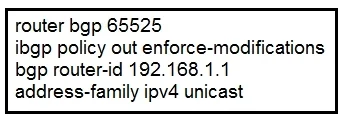
Refer to the exhibit. Router 1 is a core ABR in a Cisco Unified MPLS environment. All of the router 1 BGP peers are established, but traffic between customers is failing. Which BGP configuration…
The correct answer is C. It must be configured with send labels. Cisco Unified MPLS (also called Seamless MPLS) stitches end-to-end LSPs across multiple IGP domains using BGP as the label distribution protocol between domains. For this to work, BGP peers must advertise MPLS labels along with prefixes-this is accomplished with the…
Question
Refer to the exhibit. Router 1 is a core ABR in a Cisco Unified MPLS environment. All of the router 1 BGP peers are established, but traffic between customers is failing. Which BGP configuration must be added to the configuration?
Exhibit
Options
- AIt must be configured for graceful restart
- BIt must be configured with a route reflector
- CIt must be configured with send labels
- DIt must be configured with PIC edge
How the community answered
(56 responses)- A2% (1)
- B11% (6)
- C82% (46)
- D5% (3)
Explanation
Cisco Unified MPLS (also called Seamless MPLS) stitches end-to-end LSPs across multiple IGP domains using BGP as the label distribution protocol between domains. For this to work, BGP peers must advertise MPLS labels along with prefixes-this is accomplished with the 'send-label' (or 'send-community' with label allocation) configuration on the BGP neighbor. Without 'send labels', BGP will exchange prefixes but will not carry the MPLS label bindings needed to build a continuous LSP across domain boundaries, which explains why traffic fails even though all BGP sessions are established. Graceful restart (A) addresses control-plane failover, not label propagation. A route reflector (B) aids iBGP scalability but does not fix missing label signaling. PIC edge (D) is a fast-reroute feature unrelated to this issue.
Topics
Community Discussion
No community discussion yet for this question.