
300-510 · Question #294
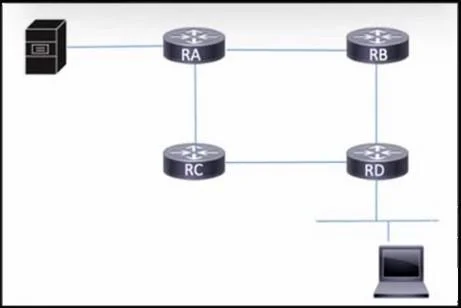
Refer to the exhibit. A host connected to router RD is attempting to connect to a new server on router RA to stream multicast data. PIM-SM is configured in the network, but multicast traffic fails…
The correct answer is B. Add an mroute to the multicast routing table to specify the correct path for the traffic. Even though RPF checks succeed, PIM-SM won’t forward the stream unless there’s an explicit (*,G) or (S,G) entry in the multicast routing table. By configuring a static mroute you force the router to install the proper incoming-interface and outgoing-interface state for that…
Question
Refer to the exhibit. A host connected to router RD is attempting to connect to a new server on router RA to stream multicast data. PIM-SM is configured in the network, but multicast traffic fails to reach the host. A network engineer checked the routing table, and the RPF check passed. Which action must the engineer take to resolve the issue?
Exhibit
Options
- AConfigure all paths from the host to the server to have the same cost.
- BAdd an mroute to the multicast routing table to specify the correct path for the traffic.
- CConfigure PIM-DM for multicast routing.
- DCorrect the TTL on the server to reflect the proper number of hops
How the community answered
(30 responses)- A13% (4)
- B73% (22)
- C10% (3)
- D3% (1)
Explanation
Even though RPF checks succeed, PIM-SM won’t forward the stream unless there’s an explicit (*,G) or (S,G) entry in the multicast routing table. By configuring a static mroute you force the router to install the proper incoming-interface and outgoing-interface state for that source-group pair, allowing the multicast traffic from RA to be delivered down to RD’s LAN.
Topics
Community Discussion
No community discussion yet for this question.