
300-510 · Question #278
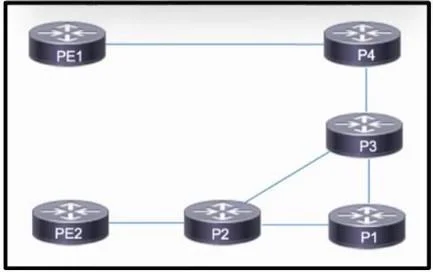
Refer to the exhibit. A regional service provider provides connectivity for several midsize businesses that run mission-critical applications between multiple offices connected via PE1 and PE2…
The correct answer is A. Implement SRLG protection to identify a post-convergence backup path. Segment-Routing Fast Reroute (SR-FRR) needs knowledge of which links share risk so it can steer traffic around a failure without waiting for full IGP reconvergence. By assigning Shared-Risk Link Groups (SRLGs) to the PE1–P4, P4–P3, P3–P2, and P2–PE2 links, the network can…
Question
Refer to the exhibit. A regional service provider provides connectivity for several midsize businesses that run mission-critical applications between multiple offices connected via PE1 and PE2. Links throughout the service provider network are connected using shared resources, and an SR-TE tunnel is in use to route traffic over different paths depending on congestion policies. The networking team must implement SR updates to reduce downtime in the event of a link failure. Which action must the team take to meet the requirements?
Exhibit
Options
- AImplement SRLG protection to identify a post-convergence backup path
- BImplement BGP timers to support immediate reconvergence when the BGP neighbor relationship
- CImplement targeted LDP neighbors to prevent unwanted LDP relationships from forming
- DImplement VRFs to segment the network and avoid large-scale network outages when a link fails
How the community answered
(39 responses)- A77% (30)
- B8% (3)
- C10% (4)
- D5% (2)
Explanation
Segment-Routing Fast Reroute (SR-FRR) needs knowledge of which links share risk so it can steer traffic around a failure without waiting for full IGP reconvergence. By assigning Shared-Risk Link Groups (SRLGs) to the PE1–P4, P4–P3, P3–P2, and P2–PE2 links, the network can calculate disjoint backup paths ahead of time. When a link in an SRLG fails, SR-FRR immediately switches to the precomputed backup, minimizing downtime.
Topics
Community Discussion
No community discussion yet for this question.