
300-510 · Question #266
Refer to the exhibit. ISP_1 uses eBGP for connection to all clients. LDP with OSPF and IS-IS is used in the ISP_1 network. Client_A and Client_B are in the same VRF_VoD. After a software upgrade on…
The correct answer is A. Configure next-hop-unchanged under the BGP configuration on R31. E. Configure send-label under the BGP configuration on R42. Two separate issues cause the connectivity loss across the eBGP boundary after the software upgrade. Answer A (next-hop-unchanged on R31): By default, an eBGP speaker changes the BGP next-hop to its own address when advertising routes to eBGP peers. In an MPLS VPN inter-AS…
Question
Refer to the exhibit. ISP_1 uses eBGP for connection to all clients. LDP with OSPF and IS-IS is used in the ISP_1 network. Client_A and Client_B are in the same VRF_VoD. After a software upgrade on all routers on the ISP_1 network, Client_A has lost the connection to Client_C. A network engineer must troubleshoot the connection from R1 to R4 via ISP_1. After initial checks, the engineer confirmed that all routes are installed correctly. Which two tasks must the engineer perform to correct the problem? (Choose two.)
Exhibit
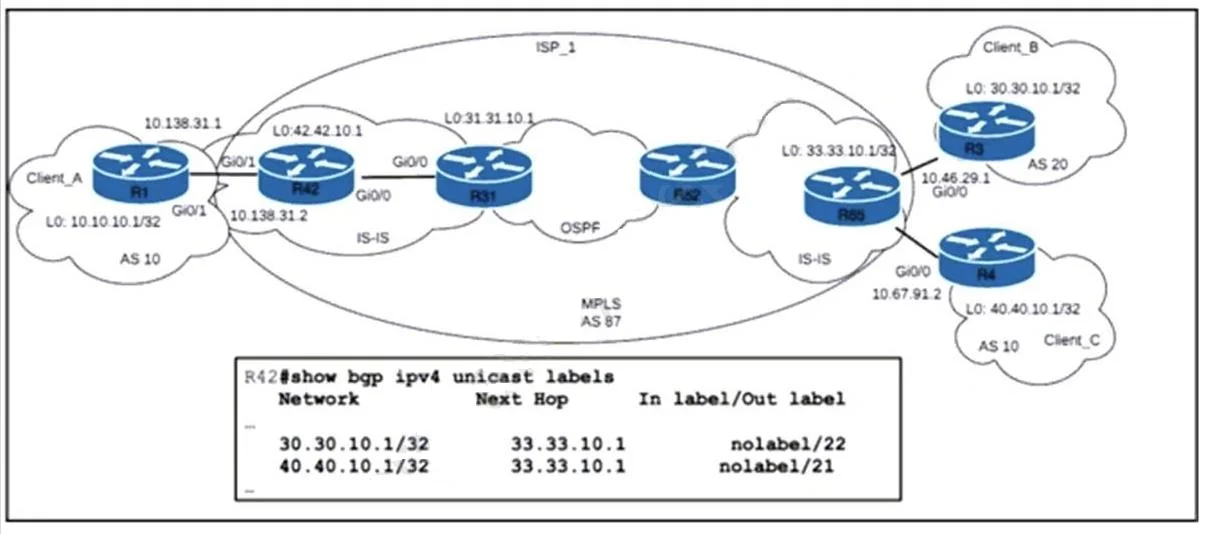
Options
- AConfigure next-hop-unchanged under the BGP configuration on R31.
- BConfigure ip cef under the global configuration on R31.
- CConfigure mpls label implicit-null under the global configuration on R31.
- DConfigure next-hop-self under the BGP configuration on R42.
- EConfigure send-label under the BGP configuration on R42.
How the community answered
(19 responses)- A68% (13)
- B11% (2)
- C5% (1)
- D16% (3)
Explanation
Two separate issues cause the connectivity loss across the eBGP boundary after the software upgrade. Answer A (next-hop-unchanged on R31): By default, an eBGP speaker changes the BGP next-hop to its own address when advertising routes to eBGP peers. In an MPLS VPN inter-AS scenario, this breaks the MPLS label stack because the original PE next-hop is needed for proper label forwarding. Configuring 'next-hop-unchanged' on R31 preserves the original next-hop, keeping the MPLS forwarding path intact. Answer E (send-label on R42): The 'send-label' command under BGP enables labeled unicast - the exchange of MPLS labels along with BGP prefixes between peers. Without this, BGP routes cross the eBGP boundary without labels, and MPLS-based forwarding cannot be established. Both are required to restore end-to-end labeled path connectivity.
Topics
Community Discussion
No community discussion yet for this question.