
300-510 · Question #213
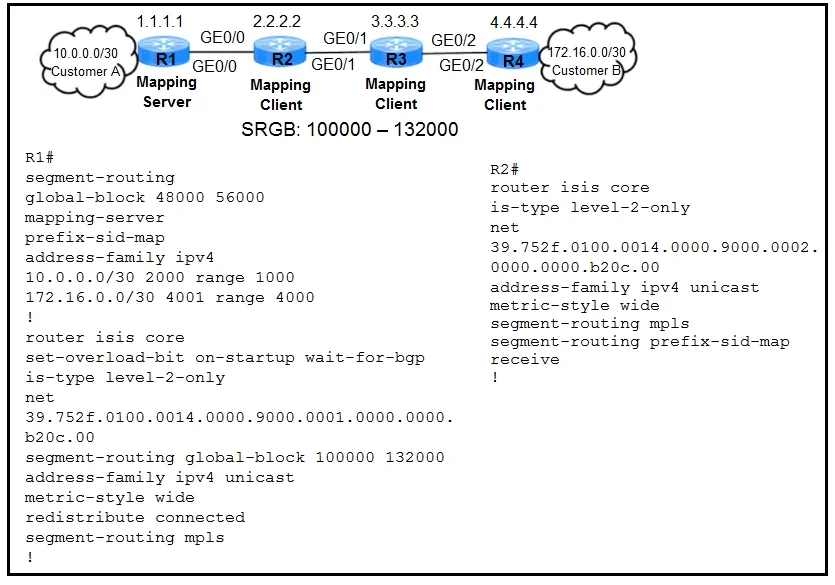
Refer to the exhibit. Customer A and customer B are connecting through a service provider network with these requirements: - R1 acts as the mapping server to connect 10.0.0.0/30 and 172.16.0.0/30…
The correct answer is B. Configure segment-routing prefix-sid-map advertise-local on R1. In Segment Routing with a mapping server/client architecture, the mapping server (R1) holds the prefix-SID mappings and must advertise them to mapping clients (R2) via BGP-LS. The command 'segment-routing prefix-sid-map advertise-local' on the mapping server (R1) enables it to…
Question
Refer to the exhibit. Customer A and customer B are connecting through a service provider network with these requirements:
- R1 acts as the mapping server to connect 10.0.0.0/30 and
172.16.0.0/30 networks
- R1 and R2 are using nondefault SRG8 range to allocate SID
- R2 ads as the mapping client for transient traffic originating from
customer A Which configuration meets the requirements?
Exhibit
Options
- ARemove allocation of prefix SlDs for 10.0.0.0/30 and 172.16.0.0/30 on R1
- BConfigure segment-routing prefix-sid-map advertise-local on R1
- CAllocate prefix SIDs for 10.0.0.0/30 and 172.16 0.0/30 subnets on R2
- DConfigure segment-routing prefix-sid-map advertise-local on R2
How the community answered
(53 responses)- A4% (2)
- B72% (38)
- C15% (8)
- D9% (5)
Explanation
In Segment Routing with a mapping server/client architecture, the mapping server (R1) holds the prefix-SID mappings and must advertise them to mapping clients (R2) via BGP-LS. The command 'segment-routing prefix-sid-map advertise-local' on the mapping server (R1) enables it to redistribute its locally configured prefix SID mappings into BGP-LS so that mapping clients can receive and use them. Without this command on R1, the mapping client R2 cannot learn the SID assignments for the 10.0.0.0/30 and 172.16.0.0/30 networks and cannot perform proper segment routing forwarding for transient traffic from Customer A.
Topics
Community Discussion
No community discussion yet for this question.