
300-510 · Question #21
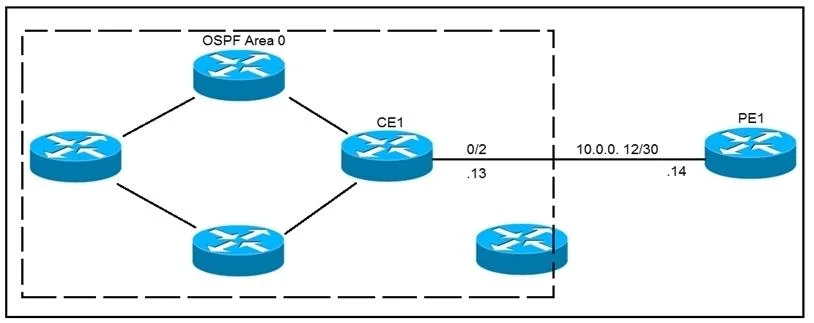
Refer to the exhibit. CE1 is the gateway router into the provider network via PE1. A network operator must inject a default route into OSPF area 0. All devices inside area 0 must be able to reach…
The correct answer is D. #CE1 ip route 0.0.0.0 0.0.0.0 GigabitEthernet0/2 10.0.0.14 ! router ospf 1 redistribute static subnets. Option D correctly uses a static default route combined with 'redistribute static subnets'. The 'subnets' keyword is critical because without it, OSPF only redistributes classful (class A/B/C) networks, and it is required to ensure all static routes, including 0.0.0.0/0, are…
Question
Refer to the exhibit. CE1 is the gateway router into the provider network via PE1. A network operator must inject a default route into OSPF area 0. All devices inside area 0 must be able to reach PE1. Which configuration achieves this goal? A. B. C. D.
Exhibits
Options
- A#CE1 router ospf 1 default-information originate always
- B#CE1 ip route 0.0.0.0 0.0.0.0 GigabitEthernet0/2 10.0.0.14 ! router ospf 1 redistribute static
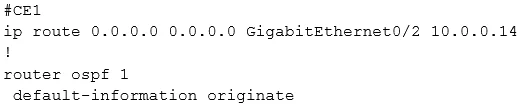
- C#CE1 ip route 0.0.0.0 0.0.0.0 GigabitEthernet0/2 10.0.0.14 ! router ospf 1 default-information originate
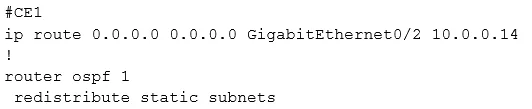
- D#CE1 ip route 0.0.0.0 0.0.0.0 GigabitEthernet0/2 10.0.0.14 ! router ospf 1 redistribute static subnets
How the community answered
(42 responses)- A17% (7)
- B7% (3)
- C2% (1)
- D74% (31)
Explanation
Option D correctly uses a static default route combined with 'redistribute static subnets'. The 'subnets' keyword is critical because without it, OSPF only redistributes classful (class A/B/C) networks, and it is required to ensure all static routes, including 0.0.0.0/0, are redistributed as OSPF external routes (Type E2 by default). This makes the default route available to all devices in area 0. Option A ('default-information originate always') injects a default route unconditionally without needing a static route, but 'always' can cause routing loops if CE1 itself has no valid path to the Internet-it is generally not recommended without a valid upstream route. Option B is missing the 'subnets' keyword, which would prevent the 0.0.0.0/0 route from being redistributed. Option C uses 'default-information originate' (without 'always'), which requires a default route to already exist in the routing table-this could work, but redistributing the static route via Option D is the more explicit and reliable approach when a static route is already configured.
Topics
Community Discussion
No community discussion yet for this question.