
300-510 · Question #204
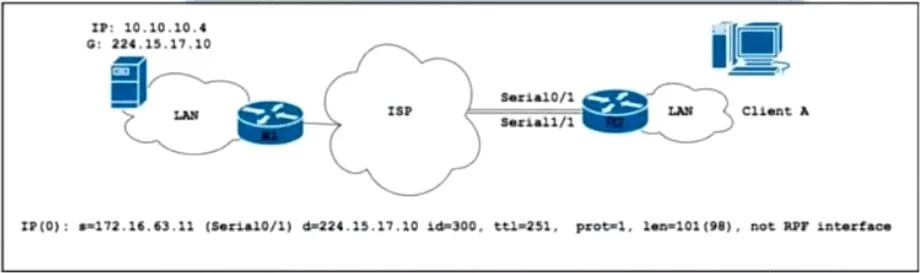
Refer to the exhibit. Mid-sized company Z connected two branch offices via a multicast-enabled ISP using the BGP routing protocol. PIM was implemented to support multicast streaming between the…
The correct answer is C. Deploy BSR on routers R1 and R2 and enable multicast on both LAN segments. For PIM Sparse Mode with MSDP to function, each domain needs a Rendezvous Point (RP), and the RP must be discoverable by all routers in the domain. BSR (Bootstrap Router) is a standards-based RP discovery mechanism (RFC 5059) that allows routers to dynamically learn the RP…
Question
Refer to the exhibit. Mid-sized company Z connected two branch offices via a multicast-enabled ISP using the BGP routing protocol. PIM was implemented to support multicast streaming between the branches via MSDP. Client A cannot connect to the multicast stream source of company Z. The network engineer ran a debug on the edge of the network as shown. Which action resolves the issue?
Exhibit
Options
- AImplement MBGP and enable a multicast address family on R2.
- BConfigure the PIM protocol on the Serial 1/1 interface and enable Auto-RP.
- CDeploy BSR on routers R1 and R2 and enable multicast on both LAN segments.
- DEnable the BGP routing protocol and advertise the 10 10.10.0/24 subnet on R1.
How the community answered
(57 responses)- A4% (2)
- B5% (3)
- C74% (42)
- D18% (10)
Explanation
For PIM Sparse Mode with MSDP to function, each domain needs a Rendezvous Point (RP), and the RP must be discoverable by all routers in the domain. BSR (Bootstrap Router) is a standards-based RP discovery mechanism (RFC 5059) that allows routers to dynamically learn the RP address. Without BSR (or Auto-RP) deployed, PIM-SM routers cannot discover the RP and therefore cannot build shared trees or register sources. Additionally, PIM and multicast routing must be enabled on all relevant interfaces - including LAN segments - so that IGMP membership reports from clients are processed and PIM joins are propagated. The debug output in the exhibit likely shows PIM failures or missing RP information. Option A (MBGP) is needed for multicast topology exchange across domains but is not the root cause shown. Options B and D address different aspects and do not resolve the BSR/PIM interface configuration gap.
Topics
Community Discussion
No community discussion yet for this question.