
300-510 · Question #197
Refer to the exhibit. HostB receives an IPTV traffic stream from the multicast source at 192.168.10.1. When router RB is powered down, it impacts multicast traffic forwarding to downstream peers…
The correct answer is A. Enable PIM sparse mode on routers RC and RZ with a static RP address of 10.10.10.1. D. Enable PIM SSM mode on routers RA and RY. RA and RB are co-located, and RB's failure disrupts multicast forwarding. Two complementary configurations provide resilience: (A) Enable PIM sparse mode on RC and RZ with a static RP address of 10.10.10.1 - this ensures that routers downstream of RB (RC and RZ) have an…
Question
Refer to the exhibit. HostB receives an IPTV traffic stream from the multicast source at 192.168.10.1. When router RB is powered down, it impacts multicast traffic forwarding to downstream peers. The RA and RB routers reside in the same physical location. Which two configurations must be implemented so that HostB receives the multicast stream even when RB is powered down? (Choose two.)
Exhibit
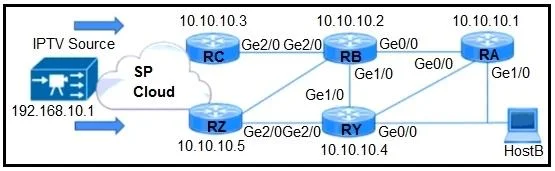
Options
- AEnable PIM sparse mode on routers RC and RZ with a static RP address of 10.10.10.1.
- BSet the backup RP address to 10.10.10.3 on routers RY and RZ.
- CEnable bi-directional PIM on all routers.
- DEnable PIM SSM mode on routers RA and RY.
- ESet the RP address to 10.10.10.4 on all routers.
How the community answered
(64 responses)- A80% (51)
- B13% (8)
- C3% (2)
- E5% (3)
Explanation
RA and RB are co-located, and RB's failure disrupts multicast forwarding. Two complementary configurations provide resilience: (A) Enable PIM sparse mode on RC and RZ with a static RP address of 10.10.10.1 - this ensures that routers downstream of RB (RC and RZ) have an explicit, statically configured RP (the RA loopback at 10.10.10.1) rather than relying on dynamic RP discovery through RB. When RB is down, RC and RZ can still register sources and join shared trees using the static RP address pointing to RA. (D) Enable PIM SSM mode on RA and RY - PIM Source-Specific Multicast (SSM) eliminates the RP dependency entirely for SSM group ranges, allowing RA (which is still online when RB fails) and RY to form (S,G) trees directly. Option B is incorrect because it sets a backup RP address that doesn't align with the described topology. Option C (bidirectional PIM) introduces shared bidirectional trees but doesn't specifically address the RB failure scenario. Option E points to an address that may not correspond to an available RP after RB fails.
Topics
Community Discussion
No community discussion yet for this question.