
300-510 · Question #164
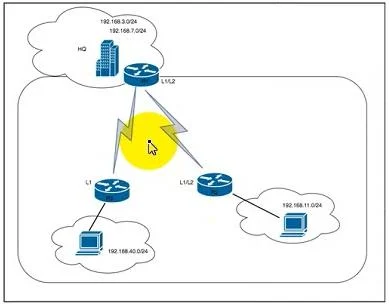
Refer to the exhibit. The branch office in area 10 is connected to HQ via Frame Relay uplinks with bandwidth constraints. After a recent implementation of QoS on the R2 and R3 networks the system…
The correct answer is D. Configure a summary route for Level 1-Level 2 devices. E. Configure a summary route for Level 1 devices. In IS-IS, summary addresses (route aggregation) are level-specific. R1 appears to be an L1/L2 router, meaning it participates in both Level 1 (intra-area) and Level 2 (inter-area) routing. The 'summary-address' command must be explicitly configured for each level where…
Question
Refer to the exhibit. The branch office in area 10 is connected to HQ via Frame Relay uplinks with bandwidth constraints. After a recent implementation of QoS on the R2 and R3 networks the system has been logging %SYS-2-MALLOCFAIL: Memory allocation of 65536 bytes failed from 0x224E321, alignment 0 messages. To reduce traffic load and memory utilization on R2 and R3 the network engineer configured R1 to announce only one user subnet per location by issuing the summary address 192.168.0.0 255.255.248.0 command en R1. However, the engineer noticed that router R2 still has two routes and a summary address from HQ and R3 also has two routes from HQ. Which two actions must the engineer take on R1 to fix the issue so that only one route is announced? (Choose two.)
Exhibit
Options
- AConfigure the subnet range with the network command under the IS-IS process.
- BConfigure RI as a Level 1 device.
- CRedistribute both routes into the ISIS process.
- DConfigure a summary route for Level 1-Level 2 devices.
- EConfigure a summary route for Level 1 devices.
How the community answered
(22 responses)- A23% (5)
- B14% (3)
- C5% (1)
- D59% (13)
Explanation
In IS-IS, summary addresses (route aggregation) are level-specific. R1 appears to be an L1/L2 router, meaning it participates in both Level 1 (intra-area) and Level 2 (inter-area) routing. The 'summary-address' command must be explicitly configured for each level where summarization is desired. If only configured for one level, routes will still be advertised individually on the other level. R2 sees two routes and a summary because summarization is applied on L2 but individual routes still leak from L1. R3 sees two routes from HQ for a similar reason. Configuring a summary route for Level 1-Level 2 devices (D) addresses the L1L2 boundary leaking, and configuring a summary route for Level 1 devices (E) ensures aggregation within the L1 domain - both are needed to ensure only one summarized route is announced across all IS-IS levels.
Topics
Community Discussion
No community discussion yet for this question.