
300-510 · Question #160
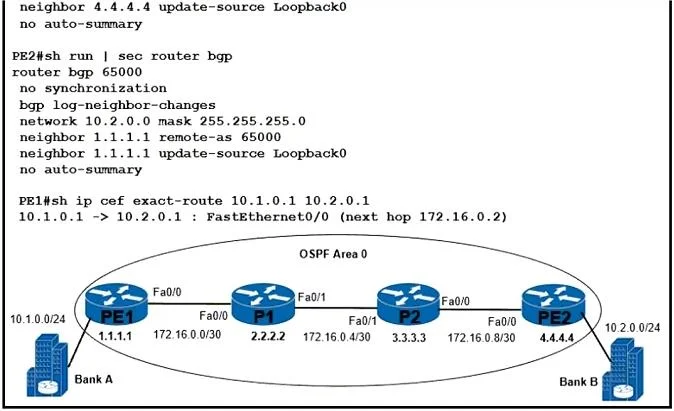
Refer to the exhibit. Network connectivity between bank A and bank B has been lost. Users at bank A and bank B are able to successfully reach their directly connected PE routers. All routers in OSPF…
The correct answer is D. Configure MPLS with an end-to-end label-switched path on each router. This is an MPLS L3 VPN scenario. Bank A and Bank B are connected to PE routers, which are connected via provider (P) routers running OSPF area 0. While CE-to-PE connectivity and IGP routing within the SP core are working, VPN traffic between the banks requires MPLS…
Question
Refer to the exhibit. Network connectivity between bank A and bank B has been lost. Users at bank A and bank B are able to successfully reach their directly connected PE routers. All routers in OSPF area 0 are correctly advertising and learning routing updates. Which action resolves the issue?
Exhibit
Options
- AEnable next-hop-self under the iBGP peering configuration on routers PE1 and PE2.
- BConfigure the P routers to redtstnbute BGP routes within OSPF area 0.
- CConfigure router P1 to advertise the IP prefix of PE1.
- DConfigure MPLS with an end-to-end label-switched path on each router.
How the community answered
(40 responses)- A5% (2)
- B15% (6)
- C8% (3)
- D73% (29)
Explanation
This is an MPLS L3 VPN scenario. Bank A and Bank B are connected to PE routers, which are connected via provider (P) routers running OSPF area 0. While CE-to-PE connectivity and IGP routing within the SP core are working, VPN traffic between the banks requires MPLS label-switched paths (LSPs) to forward packets across the provider network. Without MPLS enabled end-to-end, PE routers cannot encapsulate and forward VPN traffic using labels (inner VPN label + outer transport label). Option A (next-hop-self) would help if PE routers weren't advertising reachable next-hops in iBGP, but the core issue here is missing MPLS forwarding. Option B (redistributing BGP into OSPF) would expose customer prefixes to the SP core unnecessarily. Option C is incomplete and wouldn't establish proper VPN forwarding.
Topics
Community Discussion
No community discussion yet for this question.