
300-510 · Question #147
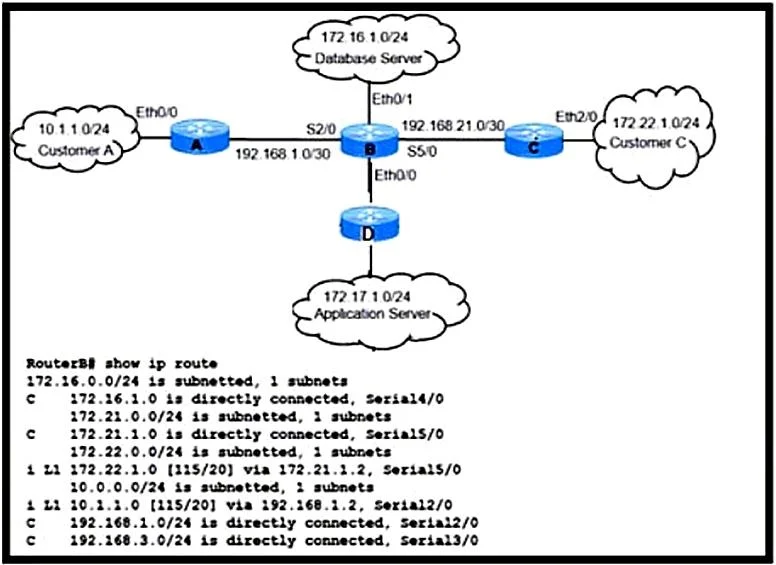
Refer to the exhibit. Customers A and C are experiencing packet drops when connecting to the application server. While troubleshooting the problem, the network engineer confines that the IS- IS…
The correct answer is A. Advertise the application server subnet in the router D IS-IS database. IS-IS Level-1/2 adjacencies are up and both customers can reach the database server, which means the IS-IS topology and basic routing are functional. The specific problem is that the application server subnet is not reachable. Since the database server is reachable but the…
Question
Refer to the exhibit. Customers A and C are experiencing packet drops when connecting to the application server. While troubleshooting the problem, the network engineer confines that the IS- IS Level-1/2 adjacency is up between routers A, B, C, and D and both customers can communicate with the database server without packet loss. Which action must the engineer take to resolve the issue?
Exhibit
Options
- AAdvertise the application server subnet in the router D IS-IS database
- BAdvertise a static default route to the router B IS-IS database.
- CLeak the 172.17.1.0/24 route in the IS-IS databases on routers A and C.
- DLeak the customer A and customer C subnets in the router A IS-IS database.
How the community answered
(50 responses)- A76% (38)
- B16% (8)
- C6% (3)
- D2% (1)
Explanation
IS-IS Level-1/2 adjacencies are up and both customers can reach the database server, which means the IS-IS topology and basic routing are functional. The specific problem is that the application server subnet is not reachable. Since the database server is reachable but the application server is not, the application server's subnet is simply not being advertised into the IS-IS domain. Router D, which connects to the application server, must be configured to redistribute or advertise the application server subnet into its IS-IS database. Without this advertisement, no IS-IS router - including A or C - will have a route to the application server. Option B (advertising a default route via R-B) would be a workaround but is not the correct targeted fix. Option C (leaking 172.17.1.0/24) addresses inter-area leaking, not a missing subnet advertisement. Option D (leaking customer subnets) addresses the opposite direction of traffic.
Topics
Community Discussion
No community discussion yet for this question.