
300-510 · Question #116
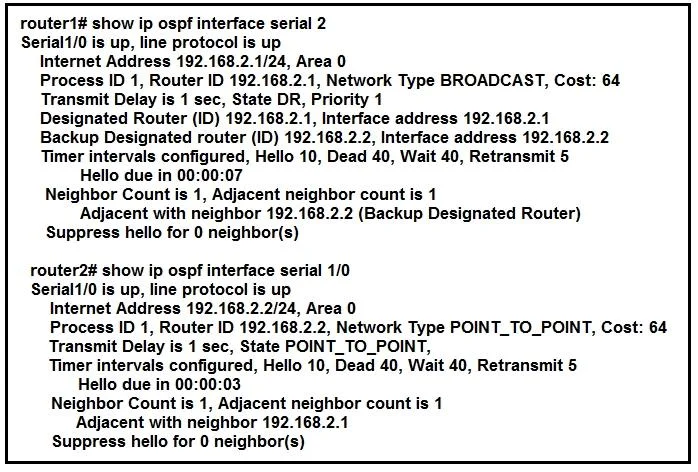
Refer to the exhibit. Router1 and Router2 have shared routes in the OSPF database, but the routes are missing from their routing tables. Checking the prefix-list configuration on both routers, the…
The correct answer is D. Configure interface Senal1/0 on Router1 as a point-to-point interface. Option D fixes the problem because a network type mismatch on Serial1/0 is the classic cause of routes appearing in the OSPF database but not the routing table - if one router's serial interface is set to a DR/BDR-requiring type (like non-broadcast/NBMA) while the other expects…
Question
Refer to the exhibit. Router1 and Router2 have shared routes in the OSPF database, but the routes are missing from their routing tables. Checking the prefix-list configuration on both routers, the engineer confirmed all networks are allowed. What action should the engineer take to fix the problem?
Exhibit
Options
- AConfigure the two routers with different process IDs
- BConfigure the two routers with different hello and dead timer values
- CSwitch the DR and BDR roles between the two routers
- DConfigure interface Senal1/0 on Router1 as a point-to-point interface
How the community answered
(38 responses)- A5% (2)
- B29% (11)
- C11% (4)
- D55% (21)
Explanation
Option D fixes the problem because a network type mismatch on Serial1/0 is the classic cause of routes appearing in the OSPF database but not the routing table - if one router's serial interface is set to a DR/BDR-requiring type (like non-broadcast/NBMA) while the other expects point-to-point, full adjacency is never achieved, leaving routes stuck in the database. Configuring Serial1/0 as ip ospf network point-to-point eliminates DR/BDR election entirely and forces a direct Full adjacency, which allows routes to be installed.
Why the others are wrong:
- A - OSPF process IDs are locally significant and never need to match between routers; mismatched IDs have no effect on adjacency or route installation.
- B - Hello/dead timers must match for adjacency formation; making them different would break the existing neighbor relationship, worsening the problem.
- C - DR/BDR role-swapping is irrelevant here; on a proper point-to-point serial link there is no DR/BDR election at all, and swapping roles does nothing to resolve a network type mismatch.
Memory tip: "Routes in the DB but not the table = suspect a network type mismatch." Serial links should almost always be point-to-point - if you see DR/BDR behavior on a serial interface, that's your red flag.
Topics
Community Discussion
No community discussion yet for this question.