
300-420 · Question #212
Refer to the exhibit. An architect is developing a solution to consolidate networks while retaining device redundancy. The routing protocol for the WAN routers must be open standard, ensure high…
The correct answer is B. one router running OSPFv2 and other OSPF v3. Running OSPFv2 and OSPFv3 concurrently provides a robust solution for consolidated networks, offering high availability, fast convergence, and support for both IPv4 and IPv6 as open standards.
Question
Refer to the exhibit. An architect is developing a solution to consolidate networks while retaining device redundancy. The routing protocol for the WAN routers must be open standard, ensure high availability, and provide the fastest convergence time. Which solution must the design include?
Exhibit
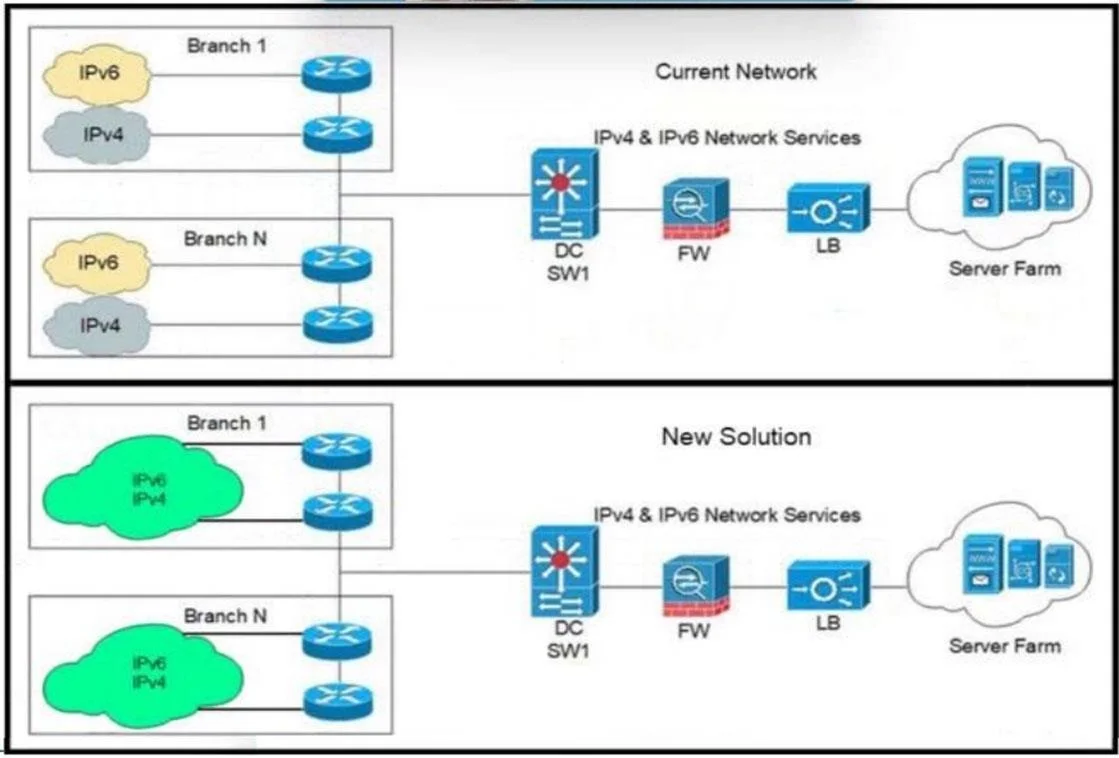
Options
- Aboth routers running EIGRP
- Bone router running OSPFv2 and other OSPF v3
- Cone router running ISIS and other OSPF v3
- Dboth routers running OSPFv2
How the community answered
(52 responses)- A4% (2)
- B67% (35)
- C19% (10)
- D10% (5)
Why each option
Running OSPFv2 and OSPFv3 concurrently provides a robust solution for consolidated networks, offering high availability, fast convergence, and support for both IPv4 and IPv6 as open standards.
EIGRP is a Cisco proprietary protocol, which does not meet the "open standard" requirement, despite its fast convergence.
Running OSPFv2 and OSPFv3 on the routers provides an open-standard solution that ensures high availability and fast convergence for both IPv4 (OSPFv2) and IPv6 (OSPFv3) traffic. This allows for network consolidation by supporting dual-stack environments effectively with a single routing protocol family.
Running ISIS and OSPFv3 means two different routing protocols would need to be managed, increasing complexity rather than consolidating networks efficiently, and ISIS is generally an IPv6 routing protocol primarily though it supports CLNP for IPv4 routing.
Both routers running OSPFv2 only provides routing for IPv4 traffic; it does not support IPv6, which is typically part of network consolidation and future-proofing.
Concept tested: OSPFv2 and OSPFv3 for dual-stack routing
Source: https://www.cisco.com/c/en/us/td/docs/ios-xml/ios/iproute_ospf/configuration/xe-3s/iro-xe-3s-book.html
Topics
Community Discussion
No community discussion yet for this question.