
300-420 · Question #211
Refer to the exhibit. A customer experienced an unexpected network outage when the link between R1 and R2 went down. An architect must design a solution to ensure network continuity in the event the…
The correct answer is A. Make R3 an L1L2 router. To provide redundancy and restore connectivity when the R1-R2 link fails, making R3 an L1L2 router allows it to serve as a backup path between Area 0 (L2) and Area 1 (L1).
Question
Refer to the exhibit. A customer experienced an unexpected network outage when the link between R1 and R2 went down. An architect must design a solution to ensure network continuity in the event the link tails again. Which solution should the design include?
Exhibit
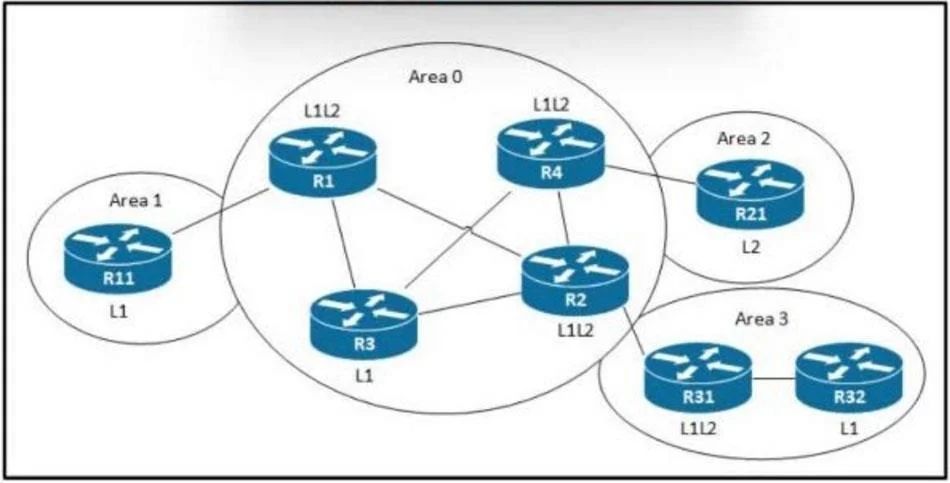
Options
- AMake R3 an L1L2 router.
- BMake R31 an L1 router.
- CMake Area 0 L2-only.
- DMake R11 an L2 router.
How the community answered
(43 responses)- A84% (36)
- B9% (4)
- C2% (1)
- D5% (2)
Why each option
To provide redundancy and restore connectivity when the R1-R2 link fails, making R3 an L1L2 router allows it to serve as a backup path between Area 0 (L2) and Area 1 (L1).
Making R3 an L1L2 router allows it to act as both an Area 0 (L2) and Area 1 (L1) router. If the primary link between R1 and R2 fails, R3 can then forward traffic between Area 0 and Area 1, ensuring network continuity and redundancy. This is a common design pattern for IS-IS multi-area networks to create backup paths.
Making R31 an L1 router would restrict its routing capabilities to within Area 1 only, preventing it from routing traffic to Area 0 and thus not providing a backup path across areas.
Making Area 0 L2-only is not a standard or beneficial IS-IS configuration for redundancy, and Area 0 is typically the backbone area, often containing L2 routers.
Making R11 an L2 router would not solve the problem of a failed R1-R2 link, as R11 is already in Area 0 and would still need a path to Area 1.
Concept tested: IS-IS L1L2 router for redundancy
Source: https://www.cisco.com/c/en/us/td/docs/ios-xml/ios/iproute_isis/configuration/xe-3s/irs-xe-3s-book.html
Topics
Community Discussion
No community discussion yet for this question.