
200-901 · Question #102
Drag and Drop Question Drag and drop the HTTP status codes from the left onto the correct descriptions on the right. Answer:
The correct answer is 401 Unauthorized; 404 Not Found; 400 Bad Request; 403 Forbidden. This drag-and-drop question tests knowledge of common HTTP 4xx client error status codes and their standard descriptions by requiring the user to correctly match each code to its meaning.
Question
Exhibit
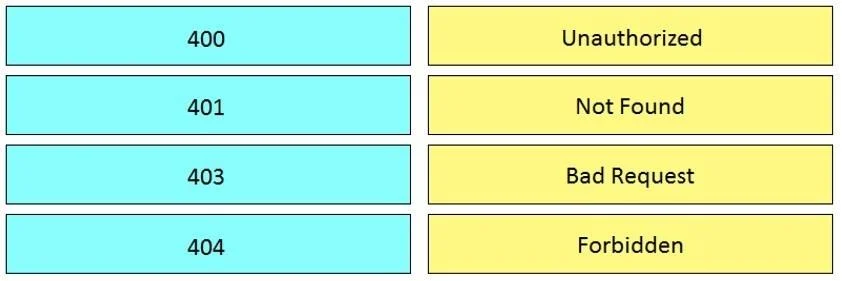
Answer Area
Drag items
Correct arrangement
- 401 Unauthorized
- 404 Not Found
- 400 Bad Request
- 403 Forbidden
Explanation
This drag-and-drop question tests knowledge of common HTTP 4xx client error status codes and their standard descriptions by requiring the user to correctly match each code to its meaning.
Approach. The correct approach is to drag each HTTP status code to its universally recognized description. The mappings are as follows:
- Drag '400' and drop it onto 'Bad Request'. This code indicates that the server cannot or will not process the request due to something that is perceived to be a client error (e.g., malformed request syntax, invalid request message framing).
- Drag '401' and drop it onto 'Unauthorized'. This code means the client must authenticate itself to get the requested response. It often involves providing credentials.
- Drag '403' and drop it onto 'Forbidden'. This code indicates that the client does not have access rights to the content; that is, it is unauthorized, so the server is refusing to give that resource. Unlike 401, authentication is often already provided but permission is still denied.
- Drag '404' and drop it onto 'Not Found'. This code signifies that the server cannot find the requested resource. The URL might be incorrect or the resource may have been moved or deleted.
Common mistakes.
- common_mistake. A common mistake is confusing '401 Unauthorized' and '403 Forbidden'. While both imply a lack of access, '401 Unauthorized' means authentication is required or failed, prompting the client to provide credentials. '403 Forbidden' means the server understands the request and the client's identity (if authenticated), but explicitly denies access to the resource, regardless of authentication attempts. Another mistake could be incorrectly associating '400 Bad Request' with an authentication or resource availability issue rather than a malformed request from the client.
Concept tested. Understanding of standard HTTP client error (4xx) status codes and their specific meanings in web communication.
Topics
Community Discussion
No community discussion yet for this question.