
200-901 · Question #103
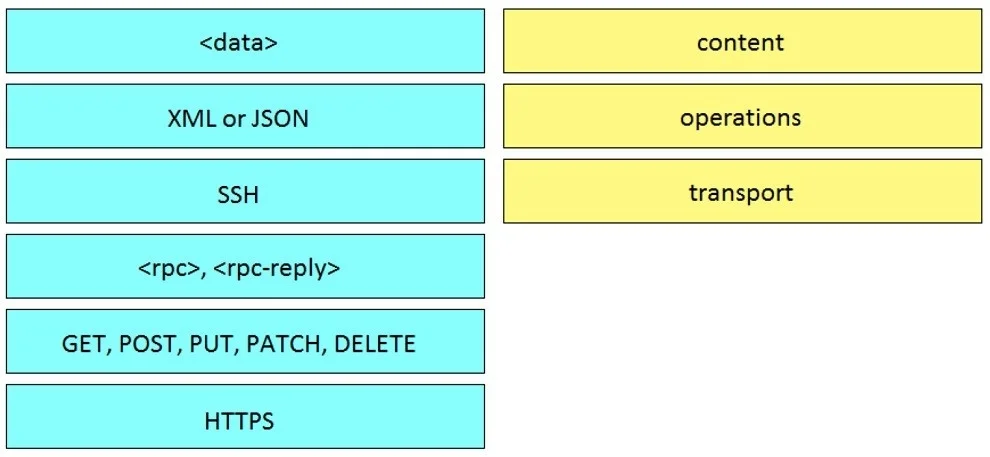
Drag and Drop Question Drag and drop elements of the RESTCONF protocol stack from the left onto the correct description on the right. Not all elements on the left are used. Answer:
The correct answer is <data>; XML or JSON; GET, POST, PUT, PATCH, DELETE; SSH; HTTPS; <rpc>, <rpc-reply>. The question assesses knowledge of the RESTCONF protocol stack by requiring the identification and mapping of its content, operations, and transport layers.
Question
Exhibit
Answer Area
Drag items
Correct arrangement
- <data>
- XML or JSON
- GET, POST, PUT, PATCH, DELETE
- SSH
- HTTPS
- <rpc>, <rpc-reply>
Explanation
The question assesses knowledge of the RESTCONF protocol stack by requiring the identification and mapping of its content, operations, and transport layers.
Approach. The correct interaction involves dragging the elements from the left column to their corresponding categories on the right:
- Drag 'XML or JSON' to 'content': The 'content' layer in RESTCONF specifies the format of the data being exchanged. RESTCONF typically uses XML or JSON for encoding the data payloads in requests and responses.
- Drag 'GET, POST, PUT, PATCH, DELETE' to 'operations': The 'operations' layer defines the actions that can be performed on resources. RESTCONF leverages standard HTTP methods (GET for retrieval, POST for creation, PUT for full update, PATCH for partial update, DELETE for removal) to implement these operations.
- Drag 'HTTPS' to 'transport': The 'transport' layer is responsible for the secure transmission of data over the network. RESTCONF, being an HTTP-based protocol, relies on HTTPS (HTTP Secure) for encrypted and authenticated communication.
The elements '<data>', 'SSH', and '<rpc>, <rpc-reply>' are not used because they are typically associated with the NETCONF protocol or are more specific XML constructs rather than general RESTCONF stack layers in this context.
Common mistakes.
- common_mistake. Common mistakes include confusing RESTCONF components with NETCONF components. For example, dragging 'SSH' to 'transport' is incorrect because SSH is the transport for NETCONF, whereas RESTCONF uses HTTPS. Similarly, dragging '<rpc>, <rpc-reply>' to 'operations' would be incorrect because these are NETCONF-specific RPC operations, while RESTCONF uses standard HTTP methods for its operations. Dragging '<data>' to 'content' is less accurate than 'XML or JSON', as '<data>' is a specific XML tag often seen in NETCONF/YANG, whereas 'XML or JSON' describes the general content serialization format for RESTCONF. Any misplacement of the correct elements would demonstrate a lack of understanding of the RESTCONF protocol's layered architecture.
Concept tested. The core concept being tested is the understanding of the RESTCONF protocol stack's architecture, including its content encoding, operational methods, and underlying transport layer, and distinguishing these from components of related protocols like NETCONF.
Reference. null
Topics
Community Discussion
No community discussion yet for this question.