
200-401 · Question #52
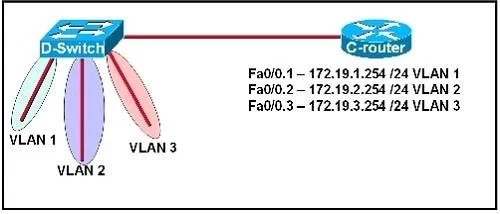
Refer to the exhibit. C-router is to be used as a "router-on-a-stick" to route between the VLANs. All the interfaces have been properly configured and IP routing is operational. The hosts in the…
The correct answer is D. No further routing configuration is required. Option D is correct because in a properly configured router-on-a-stick setup, the router's subinterfaces are each assigned an IP address on their respective VLAN subnets, which automatically places those networks into the routing table as directly connected routes - no static…
Question
Refer to the exhibit. C-router is to be used as a "router-on-a-stick" to route between the VLANs. All the interfaces have been properly configured and IP routing is operational. The hosts in the VLANs have been configured with the appropriate default gateway. What is true about this configuration?
Exhibit
Options
- AThese commands need to be added to the configuration:
- BThese commands need to be added to the configuration:
- CThese commands need to be added to the configuration:
- DNo further routing configuration is required.
How the community answered
(21 responses)- A5% (1)
- C5% (1)
- D90% (19)
Explanation
Option D is correct because in a properly configured router-on-a-stick setup, the router's subinterfaces are each assigned an IP address on their respective VLAN subnets, which automatically places those networks into the routing table as directly connected routes - no static routes or routing protocol configuration is needed to route between them. The question explicitly states that all interfaces are properly configured and IP routing is operational, meaning the subinterfaces (with 802.1Q encapsulation) and their IP addresses are already in place, making inter-VLAN routing fully functional.
Options A, B, and C are wrong because they each suggest adding routing commands (likely static routes or a routing protocol like OSPF/EIGRP) that are unnecessary for directly connected networks - routers always know their own connected subnets automatically.
Memory tip: Think "connected = free" - any network directly attached to a router interface is automatically in the routing table at no extra configuration cost. Router-on-a-stick just trades one physical interface for multiple logical subinterfaces, but the same rule applies.
Topics
Community Discussion
No community discussion yet for this question.