
200-301 · Question #21
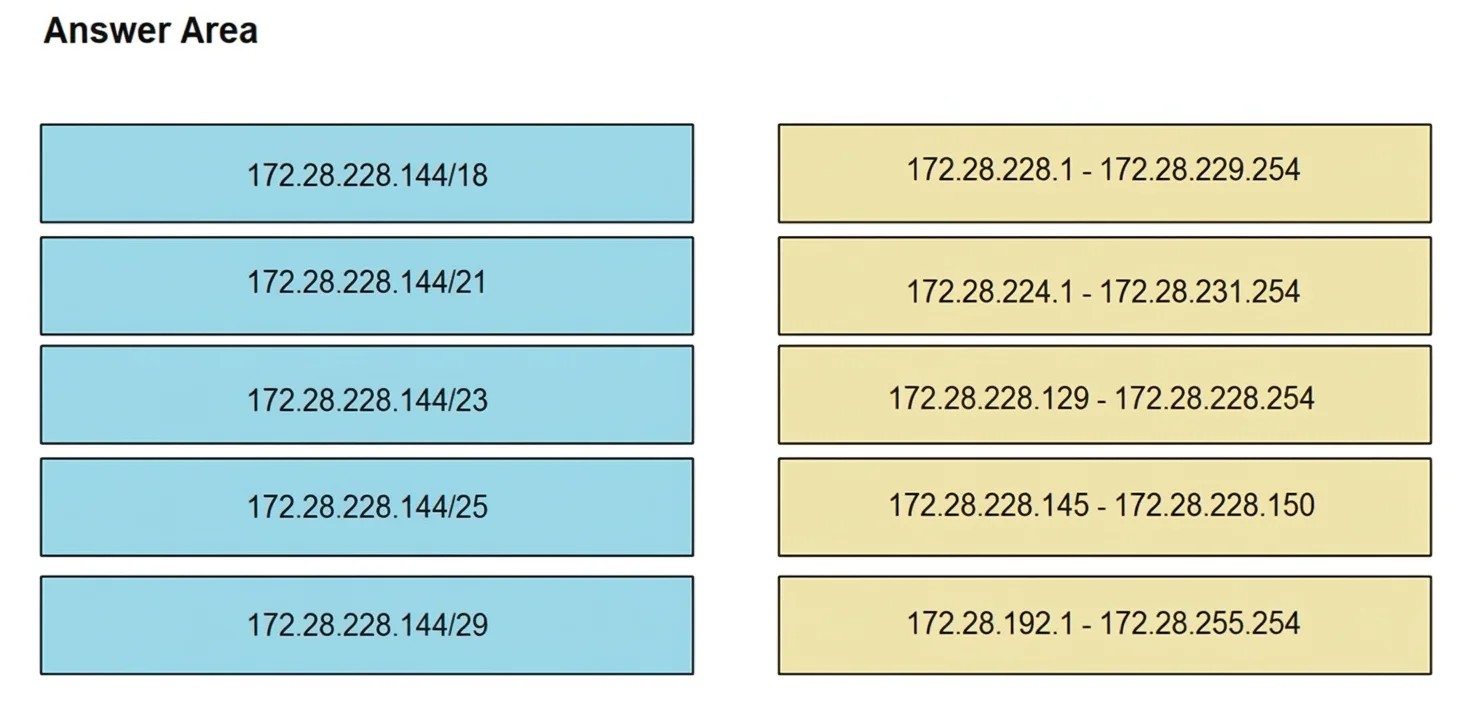
Drag and Drop Question Drag and drop the IPv4 network subnets from the left onto the correct usable host ranges on the right Answer:
IPv4 Subnetting: Drag-and-Drop Explanation The core task: given a host address with a prefix length (e.g., 172.28.228.144/18), determine which network that address belongs to, then calculate the usable host range of that network. The same host IP (172.28.228.144) appears in all…
Question
Exhibit
Explanation
IPv4 Subnetting: Drag-and-Drop Explanation
The core task: given a host address with a prefix length (e.g., 172.28.228.144/18), determine which network that address belongs to, then calculate the usable host range of that network.
The same host IP (172.28.228.144) appears in all five subnets - only the prefix length changes, which changes the network boundaries.
Key Formula
- Network address = host IP AND subnet mask
- Broadcast = network address OR (inverted mask)
- Usable range = (network + 1) to (broadcast - 1)
- Block size = 2^(32 - prefix)
Item-by-Item Breakdown
1. 172.28.228.144/18 -> 172.28.192.1 - 172.28.255.254
- Mask:
255.255.192.0; block size in 3rd octet = 64 - 228 AND 192 = 192 -> network =
172.28.192.0 - Broadcast =
172.28.255.255(192 + 64 - 1 = 255) - Usable:
.192.1->.255.254
2. 172.28.228.144/21 -> 172.28.224.1 - 172.28.231.254
- Mask:
255.255.248.0; block size in 3rd octet = 8 - 228 AND 248 = 224 -> network =
172.28.224.0 - Broadcast =
172.28.231.255(224 + 8 - 1 = 231) - Usable:
.224.1->.231.254
3. 172.28.228.144/23 -> 172.28.228.1 - 172.28.229.254
- Mask:
255.255.254.0; block size in 3rd octet = 2 - 228 AND 254 = 228 -> network =
172.28.228.0 - Broadcast =
172.28.229.255(228 + 2 - 1 = 229) - Usable:
.228.1->.229.254
4. 172.28.228.144/25 -> 172.28.228.129 - 172.28.228.254
- Mask:
255.255.255.128; block size in 4th octet = 128 - 144 AND 128 = 128 -> network =
172.28.228.128 - Broadcast =
172.28.228.255(128 + 128 - 1 = 255) - Usable:
.228.129->.228.254
5. 172.28.228.144/29 -> 172.28.228.145 - 172.28.228.150
- Mask:
255.255.255.248; block size in 4th octet = 8 - 144 AND 248 = 144 -> network =
172.28.228.144 - Broadcast =
172.28.228.151(144 + 8 - 1 = 151) - Usable:
.228.145->.228.150
Pattern to Notice
The subnets nest inside each other - each smaller prefix (/18 -> /29) carves out a progressively smaller slice, all containing 172.28.228.144:
/18  172.28.192.0   ──────────────────────────────────────
/21  172.28.224.0             ────────────────
/23  172.28.228.0                    ──────
/25  172.28.228.128                    ───
/29  172.28.228.144                     ─
Common Mistakes
| Mistake | Why it's wrong |
|---|---|
Using .144 as the network start for /25 | 144 AND 128 = 128, not 144 - the network starts at .128 |
| Forgetting the /29 network is 172.28.228.144 | Here the host address equals the network address; usable starts at .145 |
| Confusing block size in 3rd vs 4th octet | For /18-/23, the variable bits span the 3rd octet; for /25-/29, they're in the 4th |
| Off-by-one on usable range | Network address and broadcast are not usable - always add 1 / subtract 1 |
Topics
Community Discussion
No community discussion yet for this question.